
Properties of a Parallelogram by Justine Lane
Loading the math board and drawing, please wait…
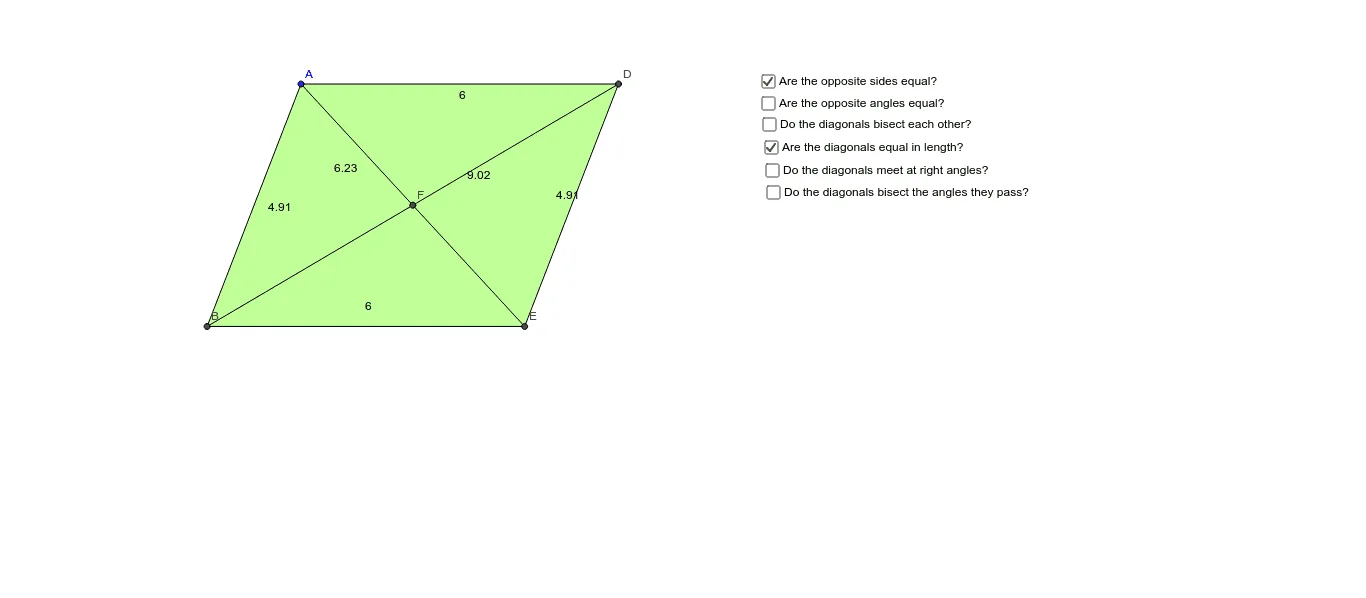
① This interactive GeoGebra applet demonstrates the fundamental properties of a parallelogram, allowing users to drag point A to resize and reshape the figure while observing how its sides, angles, and diagonals behave. ② Core mathematical concepts include: opposite sides parallel and equal, opposite angles equal, consecutive angles supplementary, and diagonals bisecting each other—all invariant under continuous deformation. ③ Construction details: based on the summary, the applet uses commands such as Intersect, Line, Point, Polygon, Segment, and Angle, creating vertices A, B, C, D, sides a, b, c, d, and multiple labeled angles (α, β, γ, δ, etc.) along with auxiliary segments (e, f, g, etc.). Dragging point A triggers dynamic updates, enabling exploration of invariant properties. ④ Suitable for middle school geometry lessons or self-study, this applet helps students discover and verify parallelogram properties through hands-on manipulation, and serves as an effective visual aid for teachers in classroom demonstrations.
GeoGebra Commands & Parameters
Intersect(xAxis, yAxis) → BLine(B, A) → aLine(A, xAxis) → bLine(B, b) → cPoint(c) → CLine(C, a) → dIntersect(b, d) → DIntersect(c, d) → EPolygon(B, A, D, E) → poly1, b_1, a_1, d_1, eSegment(B, D) → fSegment(A, E) → gIntersect(f, g) → FSegment(B, F) → hSegment(F, D) → iSegment(E, F) → jSegment(F, A) → kAngle(E, F, D) → αAngle(D, F, A) → βAngle(A, F, B) → γAngle(B, F, E) → δAngle(D, E, B) → εAngle(B, A, D) → ζAngle(A, D, E) → ηAngle(E, B, A) → θAngle(E, B, F) → ιAngle(F, B, A) → κAngle(B, A, F) → λAngle(F, A, D) → μAngle(F, E, B) → νAngle(D, E, F) → ξAngle(F, D, E) → οAngle(A, D, F) → ρ
AI Drawing Prompt Reference
Draw a parallelogram to demonstrate its properties: opposite sides are parallel and equal, opposite angles are equal, consecutive angles are supplementary, and diagonals bisect each other. Start by plotting the origin and a point on the x-axis, then draw lines to form the sides of the parallelogram. Connect the vertices to complete the shape, and draw the diagonals intersecting at a point. Mark the intersection point and draw auxiliary segments. Label all angles and segments clearly to explore the invariance of these properties as the figure is resized.
The prompt above was compiled from the original drawing commands and is for reference only.