
Properties of a Kite by eranderson
Loading the math board and drawing, please wait…
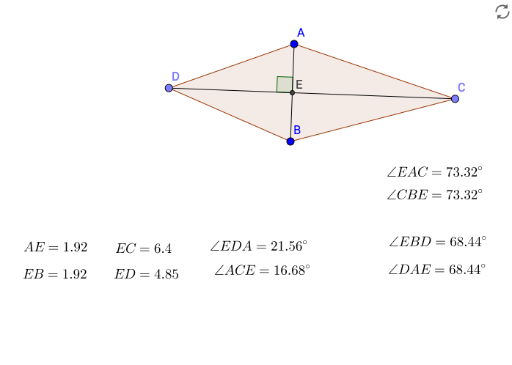
This example demonstrates the geometric properties and calculations of a kite. It involves core math concepts like polygons, angles, distances, line bisectors, and function graphs. Construction highlights include using GeoGebra commands such as Segment, LineBisector, Point, Polygon, Intersect, Distance, and Angle. Suitable for high school mathematics teaching to understand polygon properties and geometric constructions.
GeoGebra Commands & Parameters
Segment(A, B) → fLineBisector(f) → gPoint(g) → CPoint(g) → DPolygon(C, A, D, B) → poly1, c, a, d, bSegment(C, D) → hSegment(A, B) → iIntersect(h, i) → EDistance(D, E) → distanceDEDistance(E, C) → distanceECDistance(B, E) → distanceBEDistance(E, A) → distanceEAAngle(D, A, E) → αAngle(E, A, C) → βAngle(C, B, E) → γAngle(E, B, D) → δAngle(E, D, A) → εAngle(A, C, E) → ζAngle(A, E, D) → η
AI Drawing Prompt Reference
Draw a kite shape by first creating two intersecting line segments. Find their intersection point and draw the perpendicular bisectors of these segments. Locate points on the segments along the bisectors, then connect these points to form the kite. Calculate and label the distances between vertices and the angles at each vertex, using different colors or styles to distinguish the parts.
The prompt above was compiled from the original drawing commands and is for reference only.