
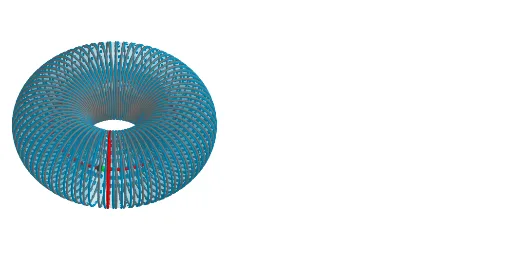
Proof without words: Volume of a torus
Loading the math board and drawing, please wait…
This example dynamically demonstrates the proof of the volume formula for a torus, involving core math concepts like cylinder volume, complex numbers, vectors, division, algebra, and variance. It utilizes commands such as Segment, CircleArc, Intersect, Vector, CurveCartesian, Ray, Point, Midpoint, Circle, Center, Sequence, Distance, Element in GeoGebra. Suitable for high school students and math enthusiasts studying solid geometry and integral applications.
GeoGebra Commands & Parameters
Segment(G, (x(G), y(G) - R)) → r_1CircleArc((0, R / (1 - Extend)), O, L, xOyPlane) → sIntersect(r_1, s, 1) → QVector(Q, G) → uCurveCartesian(t - sin(t), 1 - cos(t), t, 0, 6.28319) → bRay((0, 0), (1, 0)) → iPoint(Segment[(0, 1), (6.28319, 1)]) → HSegment(H, (x(H), 0)) → jMidpoint(j) → ICircle(L, 1 / (1 - Extend)) → pCircle((0, 0), 1 / (1 - Extend)) → qIntersect(p, q, 1) → MIntersect(p, q, 2) → NSegment((0, 0), (6.283185307179586, 0)) → eVector(G, L) → vSegment(G, Q) → dCenter(s) → BMidpoint(O, L) → DSequence(((R * sin((i * (1 - Extend))) / (1 - Extend)), (R - (R * cos((i * (1 - Extend))))) / (1 - Extend)), i, 0, (2 * π), (2 * π / m)) → l1Sequence(Vector[Element[l1, i], Element[l1, i + 1]], i, 1, Length[l1]) → l2Sequence(Circle[Element[l1, i], r, Vector[Element[l2, i]]], i, 1, Length[l1]) → l3Circle(G, R, xOyPlane) → hDistance(Element[l1, 2], Element[l1, 3]) → hautSequence(Cylinder[Element[l3, i], haut], i, 1, Length[l1]) → l4Element(l3, Section) → cMidpoint(C, A) → FVector(F, A) → wVector(F, C) → aCircle(J, r) → fPoint(f) → PCircle(J, r) → gSegment(J, P) → kMidpoint(J, P) → S
AI Drawing Prompt Reference
Draw a dynamic proof of the torus volume formula, showing the intersection of a core and a ring, with vectors indicating the direction from the core to the intersection point, a sine curve representing the rotation path, and constructing multiple cylinders to verify the volume formula, starting from basic geometric elements and gradually demonstrating complex geometric relationships and calculation processes.
The prompt above was compiled from the original drawing commands and is for reference only.