
Proof Without Words: Pythagorean Theorem by Steve Phelps
Loading the math board and drawing, please wait…
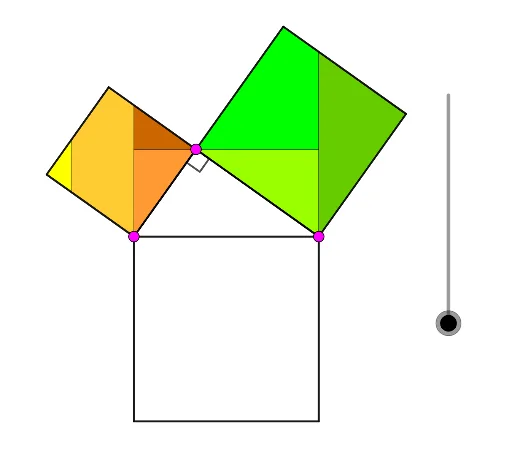
This GeoGebra example provides a wordless proof of the Pythagorean Theorem, dynamically demonstrating the area relationships between squares on the sides of a right triangle. Using geometric constructions involving semicircles, polygons, segments, and intersection points, it visually confirms a² + b² = c². Key concepts include the Pythagorean Theorem, area computation, translation, and coordinate geometry. Construction employs GeoGebra commands such as Point, Semicircle, Segment, Polygon, Angle, Line, Intersect, OrthogonalLine, Circle, and conditional If commands. Ideal for middle to high school geometry classes, it helps students visualize and understand the theorem's proof through interactive dynamic geometry.
GeoGebra Commands & Parameters
Point(xAxis) → APoint(xAxis) → BSemicircle(A, B) → cPoint(c) → CSegment(A, C) → fSegment(C, B) → gSegment(B, A) → hPolygon(A, C, 4) → poly1, i, j, k, l, G, HPolygon(C, B, 4) → poly2, m, n, p, q, I, JPolygon(B, A, 4) → poly3, r, s, t, a, K, LAngle(A, C, B) → αLine(K, A) → bLine(L, B) → dLine(C, h) → eIntersect(d, p) → FIntersect(d, e) → MIntersect(b, e) → NIntersect(b, j) → DIntersect(e, k) → EPolygon(A, N, C) → t2, c_1, a_2, n_1Polygon(D, N, C) → t3, c_2, d_2, n_2Polygon(C, M, B) → t4, b_1, c_3, m_1Polygon(C, J, F, M) → q1, c_4, j_1, f_2, m_2Polygon(B, F, I) → t5, i_1, b_2, f_3OrthogonalLine(C, h) → k_1Intersect(k_1, t) → PIntersect(k_1, h) → QCircle(H, Segment[G, D]) → d_1Intersect(d_1, l, 1) → OOrthogonalLine(O, h) → f_1Intersect(f_1, k) → RPolygon(O, R, G, D, A) → poly4, o, r_1, g_1, d_3, a_1Polygon(O, R, H) → t1, h_1, o_1, r_2If(0 < u ≤ 1, Polygon[Translate[O, Dilate[A, 1 - u, P] - A], Translate[R, Dilate[A, 1 - u, P] - A], Translate[G, Dilate[A, 1 - u, P] - A], Translate[D, Dilate[A, 1 - u, P] - A], Translate[A, Dilate[A, 1 - u, P] - A]], Polygon[Translate[O, P - A], Translate[R, P - A], Translate[G, P - A], Translate[D, P - A], Translate[A, P - A]]) → poly5If(2 < u ≤ 3, Polygon[Translate[A, A - Dilate[A, 3 - u, N]], Translate[N, A - Dilate[A, 3 - u, N]], Translate[C, A - Dilate[A, 3 - u, N]]], Polygon[Translate[A, A - N], Translate[N, A - N], Translate[C, A - N]]) → t6If(4 < u ≤ 5, Polygon[Translate[O, Q - Dilate[Q, 5 - u, R]], Translate[R, Q - Dilate[Q, 5 - u, R]], Translate[H, Q - Dilate[Q, 5 - u, R]]], Polygon[Translate[O, Q - R], Translate[R, Q - R], Translate[H, Q - R]]) → t7If(6 < u ≤ 7, Polygon[Translate[D, K - Dilate[K, 7 - u, N]], Translate[N, K - Dilate[K, 7 - u, N]], Translate[C, K - Dilate[K, 7 - u, N]]], Polygon[Translate[D, K - N], Translate[N, K - N], Translate[C, K - N]]) → t8If(8 < u ≤ 9, Polygon[Translate[B, P - Dilate[P, 9 - u, B]], Translate[F, P - Dilate[P, 9 - u, B]], Translate[I, P - Dilate[P, 9 - u, B]]], Polygon[Translate[B, P - B], Translate[F, P - B], Translate[I, P - B]]) → t9If(10 < u ≤ 11, Polygon[Translate[C, B - Dilate[B, 11 - u, M]], Translate[M, B - Dilate[B, 11 - u, M]], Translate[B, B - Dilate[B, 11 - u, M]]], Polygon[Translate[C, B - M], Translate[M, B - M], Translate[B, B - M]]) → t10If(12 < u ≤ 13, Polygon[Translate[C, L - Dilate[L, 13 - u, M]], Translate[J, L - Dilate[L, 13 - u, M]], Translate[F, L - Dilate[L, 13 - u, M]], Translate[M, L - Dilate[L, 13 - u, M]]], Polygon[Translate[C, L - M], Translate[J, L - M], Translate[F, L - M], Translate[M, L - M]]) → q2Segment(F, B) → l_1Segment(M, N) → p_1Segment(D, A) → q_1Segment(R, O) → s_1
AI Drawing Prompt Reference
Draw a right triangle and show squares on each of its sides. Include semicircles and line segments to represent area relationships. Use geometric constructions such as polygons, intersection points, angles, and perpendicular lines to demonstrate the proof of the Pythagorean theorem. Help students visualize the relationship a² + b² = c², making the theorem's proof dynamic and accessible.
The prompt above was compiled from the original drawing commands and is for reference only.