
Proof Without Words: Parallelogram Properties
Loading the math board and drawing, please wait…
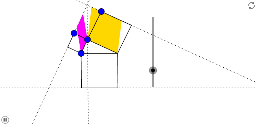
This example demonstrates the properties of a parallelogram by dragging points and sliders. It proves that the diagonals of a parallelogram bisect each other. Using GeoGebra commands such as points, line segments, vectors, and translations, the construction visually illustrates this geometric property. Suitable for middle school and above students to learn about geometric transformations and proofs.
GeoGebra Commands & Parameters
Point(xAxis) → AIntersect(xAxis, yAxis) → BCircleArc(B, D, A) → cPoint(c) → ESegment(A, E) → aSegment(E, F) → bSegment(C, E) → dSegment(E, G) → eLine(F, a) → fLine(G, d) → gIntersect(f, g) → HSegment(A, C) → hLine(H, E) → iIntersect(i, h) → ILine(A, i) → jLine(C, i) → kVector(H, E) → uTranslate(I, u) → I'Line(I', h) → lIntersect(j, l) → JIntersect(k, l) → KVector(E, A) → vVector(E, C) → wTranslate(G, w) → G'Translate(F, v) → F'Polygon(A, E, F, F') → poly1, a_1, e_1, f_1, f'Polygon(A, J, K, C) → poly2, a_2, j_1, k_1, c_1Polygon(E, G, G', C) → poly3, e_2, g_1, g', c_2Dilate(F, If[m < 1, 1 - m, 0], H) → F'_1Dilate(G, If[m < 1, 1 - m, 0], H) → G'_1Translate(F'_1, v) → LTranslate(G'_1, w) → MPolygon(A, L, F'_1, E) → poly4, a_3, l_1, f'_1, e_3Polygon(E, G'_1, M, C) → poly5, e_4, g'_1, m_1, c_3Vector(E, I) → nTranslate(H, n) → H'Dilate(H, If[1 ≤ m < 2, 2 - m, 0], H') → H'_1Vector(L, A) → pTranslate(H'_1, p) → NPolygon(L, H'_1, N, A) → poly6, l_2, h'_1, n_1, a_4Polygon(H'_1, M, C, N) → poly7, h'_2, m_2, c_4, n_2Dilate(I, If[2 ≤ m < 3, 3 - m, 0], I') → I'_1Vector(A, L) → qTranslate(I'_1, q) → OVector(I, A) → rTranslate(O, r) → O'Translate(I'_1, r) → PVector(I, C) → sTranslate(O, s) → O'_1Translate(I'_1, s) → QPolygon(O, O', P, I'_1) → poly8, o, o', p_1, i'_1Polygon(O, O'_1, Q, I'_1) → poly9, o_1, o'_1, q_1, i'_2