
Proof without words: Division of Fractions
Loading the math board and drawing, please wait…
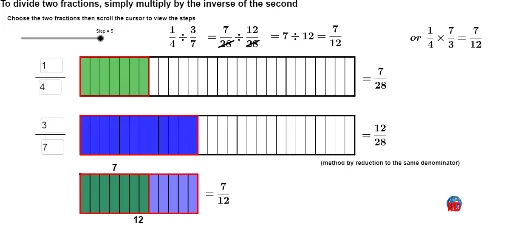
This example visually demonstrates the principle of fraction division, involving core mathematical concepts such as fraction operations, vectors, geometric constructions, and optimization problems. It utilizes commands and objects like Vector, LCM, DivPoint, Polygon, Segment, Textfield, Sequence, Point, Translate, and Midpoint in GeoGebra. Suitable for middle school mathematics education to help students intuitively understand the geometric meaning of fraction division.
GeoGebra Commands & Parameters
Vector(A, U) → v_1LCM(b, d) → oDivPoint(A, D, o) → list7DivPoint(B, C, o) → list8Polygon(A, Element[list7, t], Element[list8, t], B) → poly5, q, r, f_1, g_1Polygon(E, F, G, H) → poly2, e, f_2, g, hSegment(I, J) → iSegment(K, L) → jTextfield(a) → InputBox1Textfield(b) → InputBox2Textfield(c) → InputBox3Textfield(d) → InputBox4Polygon(A, D, C, B) → poly1, a_1, d_1, c_1, b_1DivPoint(A, D, b) → list1DivPoint(B, C, b) → list2DivPoint(E, F, d) → list3DivPoint(H, G, d) → list4Sequence(Segment[Element[list1, i], Element[list2, i]], i, 1, b) → list5Sequence(Segment[Element[list3, i], Element[list4, i]], i, 1, d) → list6Polygon(A, Element[list1, a], Element[list2, a], B) → poly3, a_2, k, l, b_2Polygon(E, Element[list3, c], Element[list4, c], H) → poly4, e_1, m, n, h_1DivPoint(E, F, o) → list9DivPoint(H, G, o) → list10Sequence(Segment[Element[list7, i], Element[list8, i]], i, 1, o) → list11Sequence(Segment[Element[list9, i], Element[list10, i]], i, 1, o) → list12Sequence(Polygon[Element[list7, (t * i)], Element[list7, (t * (i + 1))], Element[list8, (t * (i + 1))], Element[list8, (t * i)]], i, 1, p - 1) → list13Segment(M, N) → fSegment(O, P) → i_1Point(e_1) → VVector(V, U) → u_1Translate(poly5, v_1) → poly4'Translate(poly3, v_1) → poly3'Sequence(Translate[Element[list11, i], v_1], i, 0, t) → liste1Translate(k, v_1) → k'Translate(a_2, v_1) → j_1Translate(B, v_1) → B'Translate(A, v_1) → A'Segment(B', A') → k_1Translate(l, v_1) → l'Translate(e_1, u_1) → l_1Translate(H, u_1) → H'Translate(m, u_1) → m'Translate(n, u_1) → n'Midpoint(j_1) → WMidpoint(n') → ZMidpoint(m') → A_1
AI Drawing Prompt Reference
Draw a geometric figure to illustrate the concept of fraction division. Start by creating vector A and U, then calculate the least common multiple o of b and d. Next, find the division points of A, D, B, and C with respect to o, forming polygons. Use these division points and vectors to construct a series of polygons and segments, demonstrating the geometric meaning of fraction division. Finally, complete the figure by translating and finding midpoints.
The prompt above was compiled from the original drawing commands and is for reference only.