
Proof Without Words by Steve Phelps
Loading the math board and drawing, please wait…
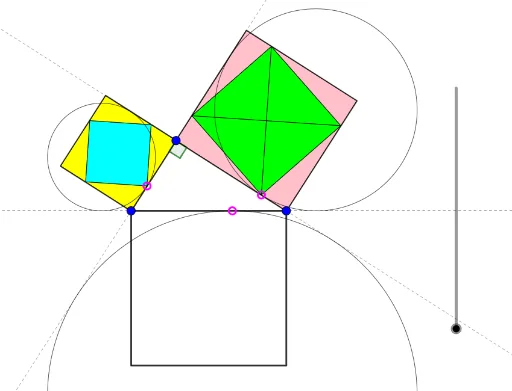
This example visually demonstrates the Intermediate Value Theorem for continuous functions through dynamic geometry. Key math concepts include continuity, slope, and triangle properties. GeoGebra commands like Point, Mirror, Semicircle, Intersect, CircleArc, Line, AngularBisector, OrthogonalLine, Circle, Polygon, Midpoint, Rotate, Angle, If are used to construct the geometric model. Suitable for high school students and math enthusiasts to visualize abstract concepts.
GeoGebra Commands & Parameters
Point(xAxis) → AMirror(A, yAxis) → A'Semicircle(A', A) → cIntersect(c, yAxis, 1) → BIntersect(xAxis, yAxis) → CCircleArc(C, B, A') → dPoint(d) → DLine(A', D) → fLine(D, A) → gLine(A, A') → hAngularBisector(f, h) → i, jAngularBisector(h, g) → k, lIntersect(j, k) → EIntersect(i, l) → FIntersect(i, k) → GOrthogonalLine(E, g) → mOrthogonalLine(F, f) → nOrthogonalLine(G, h) → pIntersect(h, p) → HIntersect(g, m) → IIntersect(f, n) → JCircle(F, J) → eCircle(E, I) → qCircle(G, H) → rPolygon(A', D, 4) → poly1, s, t, a, b, K, LPolygon(D, A, 4) → poly2, f_1, g_1, h_1, i_1, M, NPolygon(A, A', 4) → poly3, j_1, k_1, l_1, m_1, O, PMidpoint(L, D) → QMidpoint(D, M) → RMirror(J, Q) → J'Mirror(I, R) → I'Rotate(J, 90°, Q) → J'_1Mirror(J'_1, Q) → SPolygon(S, J, 4) → poly4, n_1, p_1, q_1, r_1, T, URotate(I, 90°, R) → IIPolygon(I, II, 4) → poly5, s_1, t_1, a_1, b_1, V, WMidpoint(A', P) → ZPolygon(A', S, J) → t1, j_2, a', s_2Polygon(S, L, J') → t2, j', s_3, l_2Polygon(J', K, J'_1) → t3, j'_1, c_1, k_2Polygon(J'_1, D, J) → t4, j_3, d_1, d_2Polygon(W, I', N) → t5, n_2, w, i'Polygon(W, D, I) → t6, i_2, w_1, d_3Polygon(I, A, II) → t7, i'_1, i_3, a_2Polygon(II, I', M) → t8, m_2, e_1, f_2Polygon(II, R, I') → t9, g_2, h_2, r_2Polygon(II, R, I) → t10, i_4, p_2, r_3Polygon(I, R, W) → t11, w_2, i_5, r_4Polygon(R, W, I') → t12, q_2, r_5, w_3Angle(A, A', D) → αAngle(D, A, A') → βIf(0 < o ≤ 1, Dilate[S, 1 - o, O], O) → A_1If(0 < o ≤ 1, Dilate[U, 1 - o, A'], A') → B_1If(0 < o ≤ 1, Dilate[T, 1 - o, A], A) → C_1If(0 < o ≤ 1, Dilate[J, 1 - o, P], P) → D_1If(0 < o ≤ 1, Rotate[Polygon[Translate[A', A_1 - S], Translate[S, A_1 - S], Translate[J, A_1 - S]], (o * β), A_1], Rotate[Polygon[Translate[A', A_1 - S], Translate[S, A_1 - S], Translate[J, A_1 - S]], β, A_1]) → t13If(0 < o ≤ 1, Rotate[Polygon[Translate[S, B_1 - U], Translate[L, B_1 - U], Translate[J', B_1 - U]], (o * β), B_1], Rotate[Polygon[Translate[S, B_1 - U], Translate[L, B_1 - U], Translate[J', B_1 - U]], β, A']) → t14If(0 < o ≤ 1, Rotate[Polygon[Translate[J', C_1 - T], Translate[K, C_1 - T], Translate[J'_1, C_1 - T]], (o * β), C_1], Rotate[Polygon[Translate[J', C_1 - T], Translate[K, C_1 - T], Translate[J'_1, C_1 - T]], β, A]) → t15If(0 < o ≤ 1, Rotate[Polygon[Translate[J'_1, D_1 - J], Translate[D, D_1 - J], Translate[J, D_1 - J]], (o * β), D_1], Rotate[Polygon[Translate[J'_1, D_1 - J], Translate[D, D_1 - J], Translate[J, D_1 - J]], β, P]) → t16If(2 < o ≤ 3, Dilate[I, 3 - o, O], O) → E_1If(2 < o ≤ 3, Dilate[W, 3 - o, A'], A') → F_1If(2 < o ≤ 3, Dilate[V, 3 - o, A], A) → G_1If(2 < o ≤ 3, Dilate[II, 3 - o, P], P) → H_1If(2 < o ≤ 3, Rotate[Polygon[Translate[W, E_1 - I], Translate[D, E_1 - I], Translate[I, E_1 - I]], ((o - 2) * (β - 90°)), E_1], Rotate[Polygon[Translate[W, E_1 - I], Translate[D, E_1 - I], Translate[I, E_1 - I]], β - 90°, O]) → t17If(2 < o ≤ 3, Rotate[Polygon[Translate[W, F_1 - W], Translate[I', F_1 - W], Translate[N, F_1 - W]], ((o - 2) * (β - 90°)), F_1], Rotate[Polygon[Translate[W, F_1 - W], Translate[I', F_1 - W], Translate[N, F_1 - W]], β - 90°, A']) → t18If(2 < o ≤ 3, Rotate[Polygon[Translate[II, G_1 - V], Translate[I', G_1 - V], Translate[M, G_1 - V]], ((o - 2) * (β - 90°)), G_1], Rotate[Polygon[Translate[II, G_1 - V], Translate[I', G_1 - V], Translate[M, G_1 - V]], β - 90°, A]) → t19If(2 < o ≤ 3, Rotate[Polygon[Translate[I, H_1 - II], Translate[A, H_1 - II], Translate[II, H_1 - II]], ((o - 2) * (β - 90°)), H_1], Rotate[Polygon[Translate[I, H_1 - II], Translate[A, H_1 - II], Translate[II, H_1 - II]], β - 90°, P]) → t20If(4 < o ≤ 5, Dilate[I, 5 - o, O], O) → I_1If(4 < o ≤ 5, Dilate[W, 5 - o, A'], A') → J_1If(4 < o ≤ 5, Dilate[V, 5 - o, A], A) → K_1If(4 < o ≤ 5, Dilate[II, 5 - o, P], P) → L_1If(4 < o ≤ 5, Rotate[Polygon[Translate[I, I_1 - I], Translate[R, I_1 - I], Translate[W, I_1 - I]], ((o - 4) * (β - 90°)), I_1], Rotate[Polygon[Translate[I, I_1 - I], Translate[R, I_1 - I], Translate[W, I_1 - I]], β - 90°, O]) → t21If(4 < o ≤ 5, Rotate[Polygon[Translate[R, J_1 - W], Translate[W, J_1 - W], Translate[I', J_1 - W]], ((o - 4) * (β - 90°)), J_1], Rotate[Polygon[Translate[R, J_1 - W], Translate[W, J_1 - W], Translate[I', J_1 - W]], β - 90°, A']) → t22If(4 < o ≤ 5, Rotate[Polygon[Translate[II, K_1 - V], Translate[R, K_1 - V], Translate[I', K_1 - V]], ((o - 4) * (β - 90°)), K_1], Rotate[Polygon[Translate[II, K_1 - V], Translate[R, K_1 - V], Translate[I', K_1 - V]], β - 90°, A]) → t23If(4 < o ≤ 5, Rotate[Polygon[Translate[II, L_1 - II], Translate[R, L_1 - II], Translate[I, L_1 - II]], ((o - 4) * (β - 90°)), L_1], Rotate[Polygon[Translate[II, L_1 - II], Translate[R, L_1 - II], Translate[I, L_1 - II]], β - 90°, P]) → t24If(6 < o ≤ 7, Dilate[Q, 7 - o, Z], Z) → M_1Angle(A', S, J) → δAngle(W, I, D) → εIf(6 < o ≤ 7, Rotate[Translate[poly4, M_1 - Q], ((o - 6) * β), M_1], Rotate[Translate[poly4, M_1 - Q], β, Z]) → q1Angle(A', D, A) → ζ
AI Drawing Prompt Reference
Create a dynamic geometric model demonstrating the Intermediate Value Theorem for continuous functions. Include a semicircle and two intersecting arcs, showing continuity, slope, and triangle properties. Start with horizontal and vertical lines, mirror the semicircle across the vertical line, construct arcs and lines, draw angle bisectors and perpendiculars, and finally form multiple polygons and circles to highlight geometric relationships.
The prompt above was compiled from the original drawing commands and is for reference only.