
Proof Without Words by Steve Phelps (6)
Loading the math board and drawing, please wait…
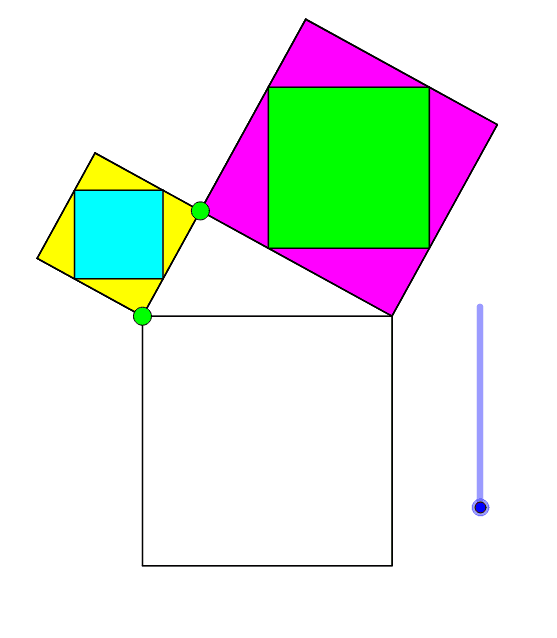
This is a geometric construction example demonstrating a proof without words. By dragging points and sliders, observe the changes in the figure to understand the underlying mathematical principles. It constructs geometric objects such as triangles, arcs, and polygons, using GeoGebra commands like points, intersections, vectors, and transformations. Suitable for high school and above students or teachers to help understand geometric transformations and proof methods.
GeoGebra Commands & Parameters
Point(xAxis) → AIntersect(xAxis, yAxis) → BCircleArc(B, D, A) → cPoint(c) → EPolygon(A, E, 4) → poly1, a, b, d, e, F, GPolygon(E, C, 4) → poly2, f, g, h, i, H, IPolygon(C, A, 4) → poly3, j, k, l, m, J, KAngularBisector(A, E, C) → nIntersect(n, j) → LOrthogonalLine(L, a) → pOrthogonalLine(L, f) → qMidpoint(G, E) → MMidpoint(E, H) → NIntersect(p, a) → OIntersect(q, f) → PMirror(O, M) → O'Mirror(P, N) → P'Line(O, j) → rLine(P, j) → sIntersect(r, e) → QIntersect(s, g) → RMirror(Q, M) → Q'Mirror(R, N) → R'Polygon(Q, O, 4) → poly4, t, a_1, b_1, c_1, S, TPolygon(P, R, 4) → poly5, d_1, e_1, f_1, g_1, U, VPolygon(Q, G, O') → poly6, o', q_1, g_2Polygon(O', F, Q') → poly7, q', o'_1, f_2Polygon(Q', O, E) → poly8, e_2, q'_1, oPolygon(O, A, Q) → poly9, q_2, o_1, a_2Polygon(E, P, R') → poly10, r', e_3, p_1Polygon(P, C, R) → poly11, r_1, p_2, c_2Polygon(R, P', H) → poly12, h_1, r_2, p'Polygon(I, R', P') → poly13, p'_1, i_1, r'_1If(0 ≤ u ≤ 1, 1 - u, If[u > 1, 0, 1]) → d1Dilate(O', d1, A) → O''Vector(O', O'') → vTranslate(poly4, v) → poly4'Dilate(R, d1, K) → R'_1Vector(R, R'_1) → wTranslate(poly5, w) → poly5'If(1 ≤ u ≤ 2, 2 - u, If[u > 2, 0, 1]) → d2Dilate(R, d2, J) → R'_2Vector(R, R'_2) → u_1Translate(R, u_1) → R'_3Translate(P', u_1) → P''Translate(H, u_1) → H'Polygon(R'_3, P'', H') → poly12', h', r'_3, p''Dilate(P, d2, W) → P'_1Vector(P, P'_1) → v_1Translate(E, v_1) → E'Translate(P, v_1) → P'_2Translate(R', v_1) → R''Polygon(E', P'_2, R'') → poly10', r'', e', p'_2Dilate(P, d2, L) → P'_3Vector(P, P'_3) → w_1Translate(P, w_1) → P'_4Translate(C, w_1) → C'Translate(R, w_1) → R'_4Polygon(P'_4, C', R'_4) → poly11', r'_4, p'_4, c'Dilate(R', d2, R'') → R''_1Vector(R', R''_1) → j_1Translate(I, j_1) → I'Translate(R', j_1) → R''_2Translate(P', j_1) → P''_1Polygon(I', R''_2, P''_1) → poly13', p''_1, i', r''_2If(2 ≤ u ≤ 3, 3 - u, If[u > 3, 0, 1]) → d3Dilate(G, d3, C') → G'Vector(G, G') → k_1Translate(Q, k_1) → Q'_1Translate(G, k_1) → G'_1Translate(O', k_1) → O''_1Polygon(Q'_1, G'_1, O''_1) → poly6', o''_1, q'_2, g'_1Dilate(O, d3, R'') → O'_1Vector(O, O'_1) → l_1Translate(Q', l_1) → Q''Translate(O, l_1) → O'_2Translate(E, l_1) → E'_1Polygon(Q'', O'_2, E'_1) → poly8', e'_1, q'', o'_2Dilate(A, d3, H') → A'Vector(A, A') → m_1Dilate(F, d3, E') → F'Vector(F, F') → n_1Translate(O, m_1) → O'_3Translate(A, m_1) → A'_1Translate(Q, m_1) → Q'_2Polygon(O'_3, A'_1, Q'_2) → poly9', q'_3, o'_3, a'_1Translate(O', n_1) → O''_2Translate(F, n_1) → F'_1Translate(Q', n_1) → Q''_1Polygon(O''_2, F'_1, Q''_1) → poly7', q''_1, o''_2, f'_1
AI Drawing Prompt Reference
Draw a geometric construction with a coordinate system, points, arcs, and polygons. Start by creating points on the axes, then use them to form arcs and polygons. Next, create new points and lines using angle bisectors and perpendiculars. Finally, apply reflections and dilations to transform the polygons and combine them, demonstrating geometric transformations and proof methods.
The prompt above was compiled from the original drawing commands and is for reference only.