
Proof Without Words by Steve Phelps (16)
Loading the math board and drawing, please wait…
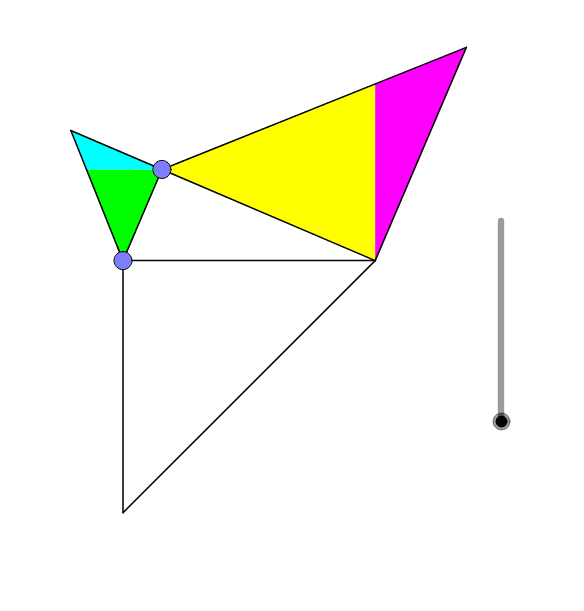
Explore the Pythagorean Theorem through dynamic geometry. Use points, circle arcs, polygons, and vectors in GeoGebra to observe changes and prove the theorem. Suitable for middle school and above students.
GeoGebra Commands & Parameters
Point(xAxis) → AIntersect(xAxis, yAxis) → BCircleArc(B, D, A) → cPoint(c) → EPolygon(A, E, 4) → poly1, a, b, d, e, F, GPolygon(E, C, 4) → poly2, f, g, h, i, H, IPolygon(C, A, 4) → poly3, j, k, l, m, J, KPolygon(A, E, F) → poly4, f_1, a_1, e_1Polygon(E, C, H) → poly5, h_1, e_2, c_1Polygon(C, A, J) → poly6, j_1, c_2, a_2OrthogonalLine(C, j_1) → nIntersect(n, c_1) → LPolygon(E, L, C) → poly7, c_3, e_3, l_1Midpoint(j_1) → MIf(o ≤ 1, o, If[1 < o, 1, 0]) → r1Rotate(E, (-(((r1 * 180))°)), M) → E'Rotate(L, (-(((r1 * 180))°)), M) → L'Rotate(C, (-(((r1 * 180))°)), M) → C'Polygon(E', L', C') → poly7', c', e', l'Polygon(C, L, H) → poly8, h_2, c_4, l_2If(1 ≤ o ≤ 2, 2 - o, If[2 < o, 0, 1]) → d1Dilate(C, d1, A) → C'_1Vector(C, C'_1) → uTranslate(C, u) → C'_2Translate(L, u) → L'_1Translate(H, u) → H'Polygon(C'_2, L'_1, H') → poly8', h', c'_2, l'_1If(1 ≤ o ≤ 2, o - 1, If[2 < o, 1, 0]) → r2Rotate(C'_2, (-(((r2 * 90))°)), C'_2) → NRotate(L'_1, (-(((r2 * 90))°)), C'_2) → ORotate(H', (-(((r2 * 90))°)), C'_2) → H''Polygon(N, O, H'') → poly8'', h'', n_1, o_1OrthogonalLine(E, n) → pIntersect(p, e_1) → PPolygon(P, A, E) → poly9, e_4, p_1, a_3If(2 ≤ o ≤ 3, 3 - o, If[3 < o, 0, 1]) → d2Dilate(E, d2, C) → E'_1Vector(E, E'_1) → vTranslate(P, v) → P'Translate(A, v) → A'Translate(E, v) → E'_2Polygon(P', A', E'_2) → poly9', e'_2, p', a'Polygon(P, F, E) → poly10, e_5, p_2, f_2If(3 ≤ o ≤ 4, 4 - o, If[4 < o, 0, 1]) → d3Dilate(E, d3, J) → E'_3Vector(E, E'_3) → wTranslate(P, w) → P'_1Translate(F, w) → F'Translate(E, w) → E'_4Polygon(P'_1, F', E'_4) → poly10', e'_4, p'_1, f'If(3 ≤ o ≤ 4, o - 3, If[4 < o, 1, 0]) → r3Rotate(P'_1, (-(((r3 * 90))°)), E'_3) → QRotate(F', (-(((r3 * 90))°)), E'_3) → F''Rotate(E'_4, (-(((r3 * 90))°)), E'_3) → RPolygon(Q, F'', R) → poly10'', r, q, f''Intersect(a_2, c') → SPolygon(S, C, H'') → poly11, h''_1, s, c_5If(4 ≤ o ≤ 5, o - 4, If[5 < o, 1, 0]) → r4Rotate(S, (-(((r4 * 180))°)), S) → S'Rotate(C, (-(((r4 * 180))°)), S) → C'_3Rotate(H'', (-(((r4 * 180))°)), S) → H'''Polygon(S', C'_3, H''') → poly11', h''', s', c'_3
AI Drawing Prompt Reference
Draw a right triangle and use arcs and squares to demonstrate the Pythagorean theorem. First, mark the points and intersection on the coordinate axes, then draw arcs and three squares on the sides of the triangle. By dynamically adjusting the positions and sizes of these shapes, observe their relationships and intuitively prove the theorem.
The prompt above was compiled from the original drawing commands and is for reference only.