
Proof Without Words by Steve Phelps (13)
Loading the math board and drawing, please wait…
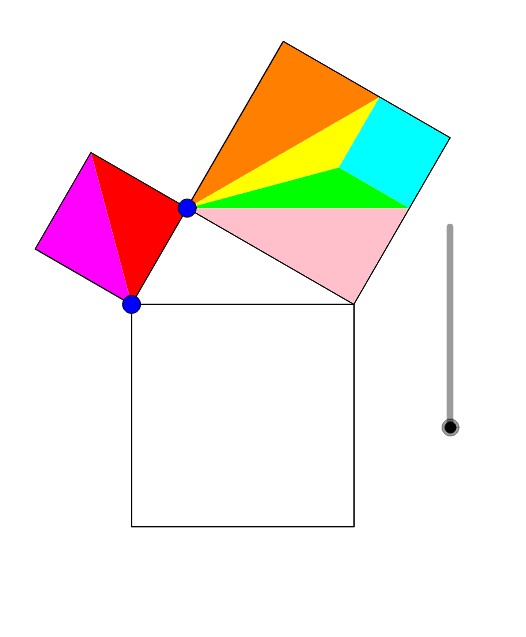
This example demonstrates the dynamic relationship between isosceles triangles, median lines, and parallelograms by dragging points and a slider. It involves core concepts like median line properties, isosceles triangle determination, and parallelogram construction. Geogebra commands used include points, circles, polygons, lines, orthogonal lines, intersections, conditions, dilations, vectors, translations, rotations, midpoints, and mirrors. Suitable for high school mathematics education to visually understand geometric theorems and transformations.
GeoGebra Commands & Parameters
Point(xAxis) → APoint(yAxis) → BCircleArc(B, D, A) → cPoint(c) → EPolygon(A, E, 4) → poly1, a, b, d, e, F, GPolygon(E, C, 4) → poly2, f, g, h, i, H, IPolygon(C, A, 4) → poly3, j, k, l, m, J, KLine(H, C) → nOrthogonalLine(K, n) → pOrthogonalLine(A, n) → qOrthogonalLine(J, p) → rIntersect(q, r) → LIntersect(p, r) → MIntersect(n, p) → NIntersect(n, q) → OPolygon(G, F, A) → poly4, a_1, g_1, f_1Polygon(F, E, A) → poly5, a_2, f_2, e_1Intersect(r, h) → PPolygon(H, P, 4) → poly7, s, t, b_1, c_1, Q, RPolygon(E, P, Q) → poly6, q_1, e_2, p_1Polygon(E, R, Q) → poly8, q_2, e_3, r_1Polygon(E, I, P) → poly9, p_2, e_4, i_1Polygon(E, C, R) → poly10, r_2, e_5, c_2If(0 ≤ o < 1, 1 - o, If[o ≥ 1, 0, 1]) → d1Dilate(R, d1, N) → R'Vector(R, R') → uTranslate(poly7, u) → poly7'If(1 ≤ o < 2, 2 - o, If[o ≥ 2, 0, 1]) → d2Dilate(E, d2, L) → E'Vector(E, E') → vTranslate(F, v) → F'Translate(E, v) → E'_1Translate(A, v) → A'Polygon(F', E'_1, A') → poly5', a', f', e'_1If(2 ≤ o < 3, 3 - o, If[o ≥ 3, 0, 1]) → d3Dilate(G, d3, N) → G'Vector(G, G') → wTranslate(G, w) → G'_1Translate(F, w) → F'_1Translate(A, w) → A'_1Polygon(G'_1, F'_1, A'_1) → poly4', a'_1, g'_1, f'_1If(3 ≤ o < 4, 4 - o, If[o ≥ 4, 0, 1]) → d4Dilate(E, d4, A) → E'_2Vector(E, E'_2) → u_1Translate(E, u_1) → E'_3Translate(R, u_1) → R'_1Translate(Q, u_1) → Q'Polygon(E'_3, R'_1, Q') → poly8', q', e'_3, r'_1If(3 ≤ o < 4, o - 3, If[o ≥ 4, 1, 0]) → r1Rotate(E'_3, (-(((r1 * 90))°)), E'_3) → SRotate(R'_1, (-(((r1 * 90))°)), E'_3) → TRotate(Q', (-(((r1 * 90))°)), E'_3) → Q''Polygon(S, T, Q'') → poly8'', q'', s_1, t_1Midpoint(M, C) → UIf(4 ≤ o < 5, o - 4, If[o ≥ 5, 1, 0]) → r2Rotate(E, (-(((r2 * 180))°)), U) → E'_4Rotate(C, (-(((r2 * 180))°)), U) → C'Rotate(R, (-(((r2 * 180))°)), U) → R'_2Polygon(E'_4, C', R'_2) → poly10', r'_2, e'_4, c'If(5 ≤ o < 6, 6 - o, If[o ≥ 6, 0, 1]) → d5Dilate(E, d5, A) → E'_5Mirror(E, p_1) → E'_6Mirror(I, p_1) → I'Mirror(P, p_1) → P'Polygon(E'_6, I', P') → poly9', p', e'_6, i'Mirror(E, p_1) → E'_7Mirror(P, p_1) → P'_1Mirror(Q, p_1) → Q'_1Polygon(E'_7, P'_1, Q'_1) → poly6', q'_1, e'_7, p'_1If(6 ≤ o < 7, 7 - o, If[o ≥ 7, 0, 1]) → d6Dilate(C, d6, O) → C'_1Vector(C, C'_1) → v_1Translate(E'_6, v_1) → VTranslate(I', v_1) → I''Translate(P', v_1) → P''Polygon(V, I'', P'') → poly9'', p'', v_2, i''If(7 ≤ o < 8, 8 - o, If[o ≥ 8, 0, 1]) → d7Dilate(P'_1, d7, C) → WIf(7 ≤ o < 8, o - 7, If[o ≥ 8, 1, 0]) → r3Vector(P'_1, W) → w_1Translate(E'_7, w_1) → ZTranslate(P'_1, w_1) → A_1Translate(Q'_1, w_1) → B_1Polygon(Z, A_1, B_1) → poly6'', b_2, z_1, a_3Rotate(Z, ((r3 * 90))°, A_1) → Z'Rotate(A_1, ((r3 * 90))°, A_1) → C_1Rotate(B_1, ((r3 * 90))°, A_1) → D_1Polygon(Z', C_1, D_1) → poly6''', d_1, z', c_3
AI Drawing Prompt Reference
Place two points on the coordinate axes, draw an arc centered at one point, pick a point on the arc, and connect the three points to form a triangle. Based on this triangle, construct three parallelograms outward, and draw relevant altitudes and perpendiculars. Use intersections of perpendiculars to define new points, forming several small triangles and quadrilaterals. Then, use a slider to control a series of dilations and translations, moving parts of the figure along specific directions, dynamically showing the area relationships between triangles and parallelograms, resulting in a proof-without-words geometric animation.
The prompt above was compiled from the original drawing commands and is for reference only.