
Proof of Triangle Area (Related to Rectangle)
Loading the math board and drawing, please wait…
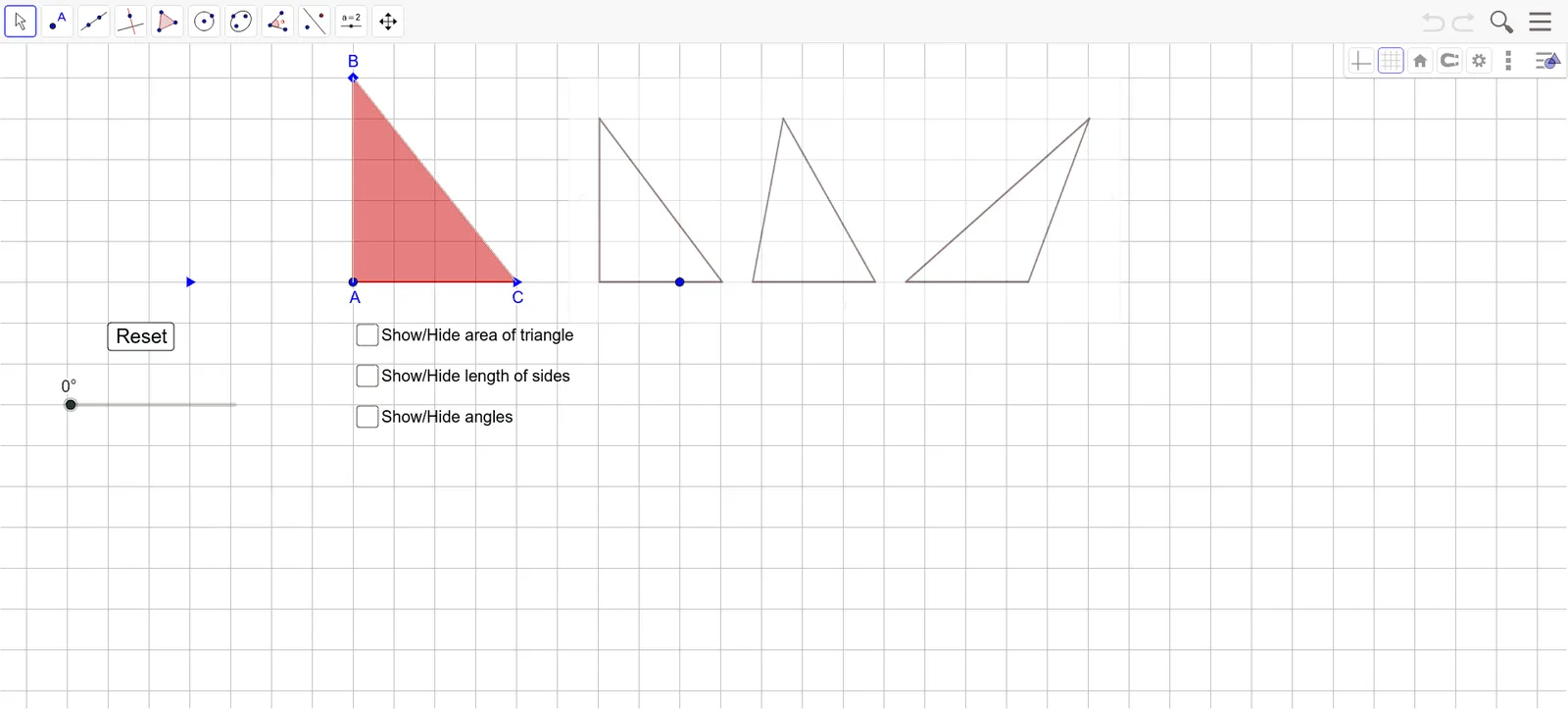
This example demonstrates proving the area formula of a triangle by constructing a related rectangle. Key mathematical concepts include the triangle area formula, the rectangle area formula, and geometric transformations. Using GeoGebra commands such as Line, Point, Polygon, etc., the relationship between the triangle and the rectangle is visually illustrated. Suitable for middle school and above students to learn geometric proofs and area calculations.
GeoGebra Commands & Parameters
Line(A, xAxis) → f_1Point(f_1) → MRay(A, M) → h_1Point(h_1) → CVector(C, A) → vMidpoint(B, C) → M_{BC}Rotate(A, (-ζ), M_{BC}) → ISegment(C, A) → iOrthogonalLine(I, i) → qIntersect(q, i) → G_1Vector(A, C) → uMidpoint(B, A) → M_{AB}Rotate(C, ε, M_{AB}) → JOrthogonalLine(J, i) → kIntersect(k, i) → E_1Polygon(A, B, C) → Area, c, a, bAngle(C, A, B) → αAngle(A, B, C) → βAngle(B, C, A) → γSegment(A, B) → gSegment(B, C) → hPolygon(A, B, C) → poly1, c_1, a_1, b_1OrthogonalLine(B, i) → jIntersect(j, i) → DPolygon(B, D, C) → poly2, c_2, b_2, d_1Polygon(B, A, D) → poly3, d_2, b_3, a_2Rotate(B, (-δ), M_{BC}) → B'Rotate(D, (-δ), M_{BC}) → LRotate(C, (-δ), M_{BC}) → C'Polygon(B', L, C') → poly2', c', b', d'Rotate(B, δ, M_{AB}) → B'_1Rotate(A, δ, M_{AB}) → A'Rotate(D, δ, M_{AB}) → KPolygon(B'_1, A', K) → poly3', d'_1, b'_1, a'Segment(B, D) → dRotate(A, ε, M_{AB}) → A'_1Rotate(B, ε, M_{AB}) → B'_2Polygon(A'_1, B'_2, J) → poly1', c'_1, a'_1, b'_2Polygon(Translate[J, Vector[(l * u)]], Translate[E_1, Vector[(l * u)]], Translate[A, Vector[(l * u)]]) → poly5, m, n, pPolygon(J, E_1, A) → poly4, a_3, c'_2, e_1Intersect(m, n) → F_1Rotate(B, (-ζ), M_{BC}) → B'_3Rotate(C, (-ζ), M_{BC}) → C'_2Polygon(I, B'_3, C'_2) → poly1'_1, c'_3, a'_2, b'_3Polygon(Translate[I, Vector[(o * v)]], Translate[G_1, Vector[(o * v)]], Translate[C, Vector[(o * v)]]) → poly7, r, s, tPolygon(I, G_1, C) → poly6, c_3, a'_3, g_1Intersect(r, s) → H_1Polygon(J, A, E_1) → poly8, e_2, c'_4, a_4Polygon(I, G_1, C) → poly9, c_4, a'_4, g_2Intersect(e_2, a_4) → I_1Intersect(e_2, c'_4) → J_1Point(a_4) → K_1Polygon(I_1, J_1, K_1) → poly10, k_1, i_1, j_1Mirror(C, A) → C'_1Mirror(A, C) → A'_2OrthogonalLine(C, b'_2) → l_1Intersect(l_1, b'_2) → EPolygon(E, C, B) → poly11, b_4, n_1, c_5Vector(B, J) → wTranslate(E, w) → N'Translate(C, w) → C'_3Translate(B, w) → B'_4Polygon(Translate[E, Vector[(l * w)]], Translate[C, Vector[(l * w)]], Translate[B, Vector[(l * w)]]) → poly11', m_1, p_1, q_1Intersect(q_1, m_1) → FOrthogonalLine(A, b'_3) → r_1Intersect(b'_3, r_1) → GPolygon(B, G, A) → poly12, s_1, t_1, f_2Vector(B, I) → u_1Translate(B, u_1) → B'_5Translate(G, u_1) → HTranslate(A, u_1) → A'_3Polygon(Translate[B, Vector[(o * u_1)]], Translate[G, Vector[(o * u_1)]], Translate[A, Vector[(o * u_1)]]) → poly12', h_2, i_2, j_2Intersect(h_2, i_2) → N