
Proof of Hyperbolic Reflection
Loading the math board and drawing, please wait…
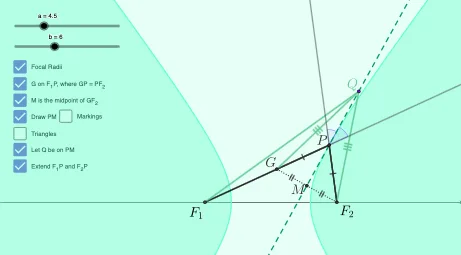
① This GeoGebra example demonstrates the construction and proof of hyperbolic reflection, visually showing how reflection preserves geometric and metric relationships on a hyperbola. ② Core mathematical concepts include hyperbola, reflection transformation, dilation, sequences and series, quadratic functions, hypothesis testing, and right triangle properties, integrating geometry with algebraic verification. ③ Construction highlights: based on the summary, it uses commands such as Segment, Point, Circle, Intersect, Midpoint, Line, Polygon, Angle, and Ray, with auxiliary objects including foci F_1, F_2, vertices V_1, V_2, and text labels (text1–text6) to annotate proof steps. ④ Suitable for high school to undergraduate geometry instruction, especially for analytic geometry, hyperbola properties, and transformation geometry, and for students to independently explore the mathematical essence of reflection.
GeoGebra Commands & Parameters
Segment(E, D) → jPoint(d) → PSegment(F_1, P) → eSegment(P, F_2) → fCircle(P, F_2) → hIntersect(h, e, 1) → GSegment(P, G) → iSegment(P, F_2) → mSegment(G, F_2) → nMidpoint(n) → MLine(P, M) → qPolygon(M, P, F_2) → poly2, f_2, c_2, a_2Segment(M, G) → rSegment(M, F_2) → sAngle(P, M, G) → αPoint(q) → QSegment(F_2, Q) → tSegment(Q, G) → d_1Segment(F_1, Q) → e_1Angle(G, P, M) → βAngle(M, P, F_2) → γRay(F_1, P) → f_1Point(f_1) → APoint(q) → BAngle(A, P, B) → δRay(F_2, P) → g_1Point(g_1) → CAngle(B, P, C) → ε