
Projectile motion: free fall with horizontal initial velocity
Loading the math board and drawing, please wait…
In collections
The Domain of the Time (intuitive kinematics)
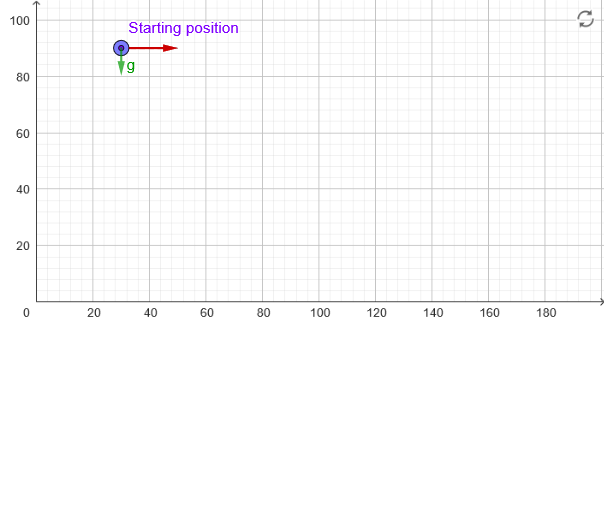
This GeoGebra example demonstrates how an object undergoes free fall when it also has a horizontal initial velocity, visualizing the evolving position over time and its geometric correspondence. The core mathematics includes 2D coordinate geometry, parameterized motion, the parabola as the trajectory, and vectors to represent and decompose the initial/instantaneous velocity into horizontal and vertical components. Construction highlights: PointIn is used to define key points, and Textfield displays parameters and annotations. Sequence together with time variables (t, dt, tt, and pause controls) drives the animation through a discrete time-stepping process approximating continuous motion. Segment and Vector create the visual velocity/displacement vectors (e.g., v, v0, v0y, vx) and track key points (such as P) that locate the moving object. The parabola is produced by generating and marking points along the computed path (using arc/marking mechanisms like verArco, marksN, marksT), allowing learners to connect the algebraic time evolution with the resulting geometric curve. Suitable for secondary school through early university, for lessons on parametric trajectories, analytic geometry, and modeling projectile motion.
GeoGebra Commands & Parameters
PointIn(x ≥ 0 ∧ y ≥ 0) → PTextfield(vx) → CasillaDeEntrada1Sequence(Text[("" * reg(Length[mark] - k + 1)) + "''", (x(P) + (vx * k) + x(Corner[2] - Corner[1]) / 18, mark(Length[mark] - k + 1))], k, 1, Length[mark]) → marksNSequence(Segment[(x(P) + (vx * k), mark(Length[mark] - k + 1)), (x(P) + (vx * k) + x(Corner[2] - Corner[1]) / 20, mark(Length[mark] - k + 1))], k, 1, Length[mark]) → marksSegment(P, (x(P), 0)) → hVector((x(M), y(P)), (x(M) + vx, y(P))) → v0Sequence(Segment[(x(P) + (vx * k), y(P) - (4.905 * k^(2))), (0, y(P) - (4.905 * k^(2)))], k, 1, Length[mark]) → marksTVector((x(P), y(M)), (x(P), y(M + v))) → v0y
AI Drawing Prompt Reference
Draw the trajectory of an object under both horizontal initial velocity and free fall. Start by placing a point P in the first quadrant as the initial position, then define a horizontal velocity vx. Use a sequence to draw marker points along the horizontal direction from point P, and draw a displacement vector from P vertically downward. Next, calculate the vertical displacement at each time step using the acceleration due to gravity, and draw a displacement vector from P vertically. Finally, connect point P to a point on the x-axis to represent horizontal displacement, forming a parabolic trajectory.
The prompt above was compiled from the original drawing commands and is for reference only.