
Prism Dispersion: Refraction and Separation of Light through a Triangular Prism
Loading the math board and drawing, please wait…
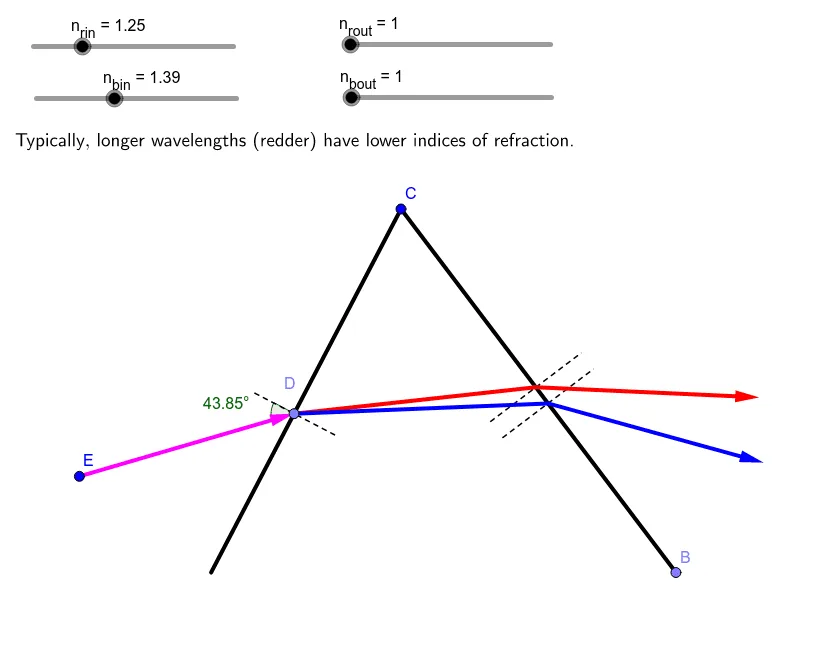
① This example demonstrates how a beam of white (or composite) light passing through a triangular prism is dispersed into different colors (e.g., red and blue), illustrating wavelength-dependent refraction. ② Core mathematical concepts include Snell's law of refraction, angle measurement, symmetry, and geometric construction of light paths; it involves triangles, angles, vectors, and proportional relationships. ③ Construction highlights: using GeoGebra commands such as Point, Intersect, Segment, Ray to define prism boundaries and incident/emergent rays; Angle and Rotate to control incidence and refraction angles; Vector to represent ray directions; CircleSector and PointIn to visualize the dispersion region; sliders (e.g., a, da, db) to dynamically adjust prism angle or refractive index; LaTeX for labeling angles and formulas. ④ Suitable for high school physics or mathematics electives covering light dispersion and refraction, as well as introductory university optics, helping students understand the relationship between wavelength and refractive index.
GeoGebra Commands & Parameters
Point(xAxis) → BIntersect(xAxis, yAxis) → ASegment(C, A) → cSlope(c) → m_cPoint(c) → DCircleSector(D, D - (Length[c] * (1, (-1) / m_c)), A) → kSegment(C, B) → bPointIn(k) → EVector(E, D) → uSlope(b) → m_bSegment(D_{plus}, D_{minus}) → aAngle(E, D, D_{minus}) → daRotate(D_{plus}, (db / 180 * π), D) → FRay(D, F) → dIntersect(d, b) → GSegment(D, G) → eSegment(G_{minus}, G_{plus}) → fAngle(D, G, G_{minus}) → gaRotate(G_{plus}, (((-gb)) / 180 * π), G) → HVector(G, G + (Vector[G, H] / Length[Vector[G, H]] * Length[u])) → gRotate(D_{plus}, (db2 / 180 * π), D) → IRay(D, I) → hIntersect(h, b) → JSegment(J_{minus}, J_{plus}) → iAngle(D, J, J_{minus}) → jaRotate(J_{plus}, (((-jb)) / 180 * π), J) → KVector(J, J + (Vector[J, K] / Length[Vector[J, K]] * Length[u])) → wSegment(D, J) → jLaTeX("\text{Typically, longer wavelengths (redder) have lower indices of refraction.}") → text1
AI Drawing Prompt Reference
Draw a triangular prism with a beam of white light entering from the left, refracting inside the prism, and dispersing into different colors (e.g., red and blue) exiting to the right. The prism is bounded by three line segments. The incident ray meets the prism surface, bends inside, and refracts again at the exit face. Label the angles of incidence and refraction, and use arrows to indicate ray directions. Include sliders to adjust the prism angle and refractive index, showing how different wavelengths bend differently. Use a circular sector or region to visualize the dispersion spread, and add a text note that longer wavelengths (redder) have lower indices of refraction.
The prompt above was compiled from the original drawing commands and is for reference only.