
Primitive Roots and Order
Loading the math board and drawing, please wait…
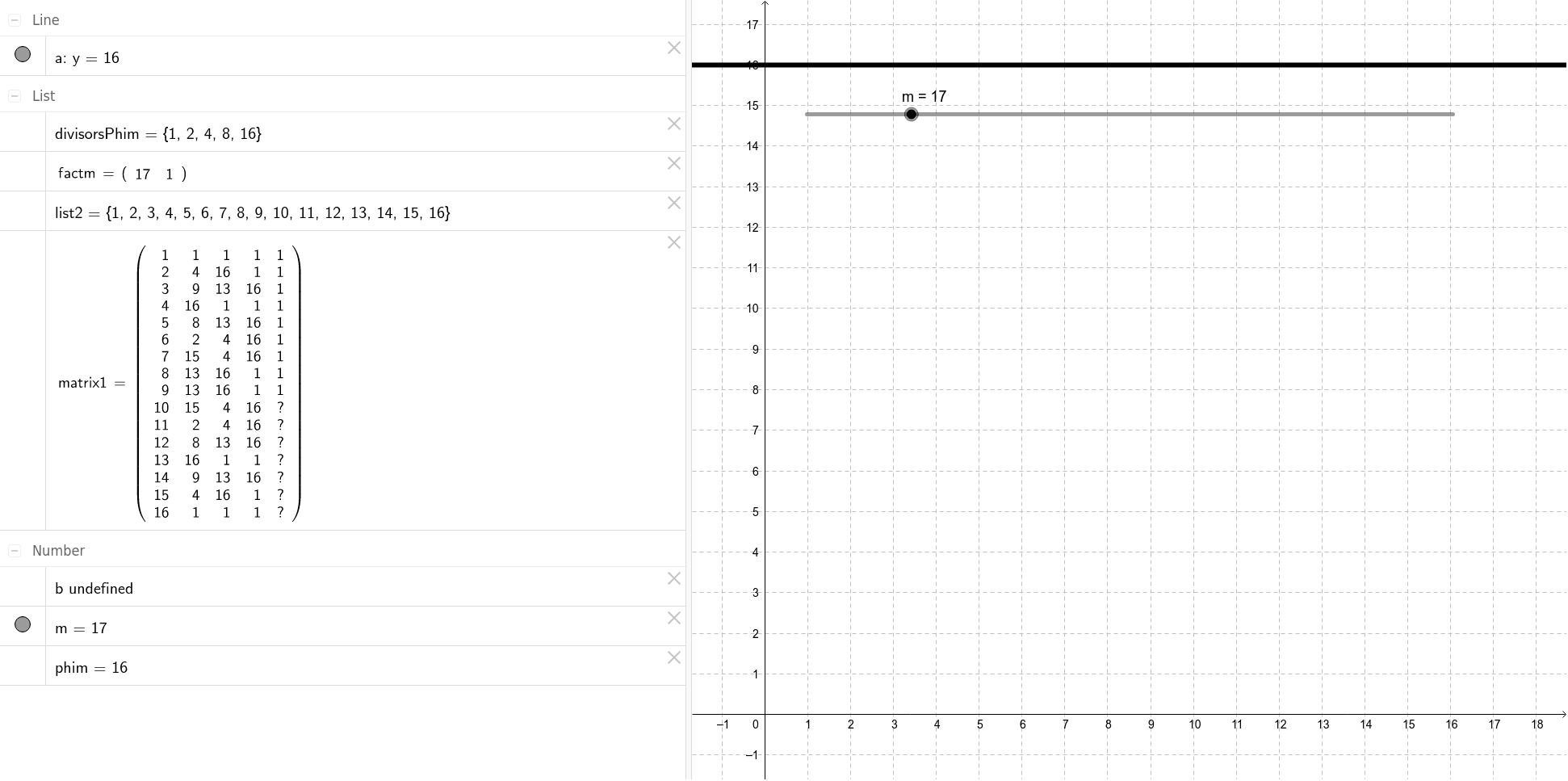
This example demonstrates the concept of primitive roots and order. By calculating the order of each number i under modulo m, the properties of primitive roots can be observed. Key mathematical concepts include primitive roots and order in number theory. Construction highlights include using the Sequence command to generate sequences and the Mod command for modular arithmetic. Suitable for elementary number theory courses.
GeoGebra Commands & Parameters
Factors(m) → factmProduct(Sequence[(Element[factm, n, 1]^(Element[factm, n, 2] - 1) * (Element[factm, n, 1] - 1)), n, 1, Length[factm]]) → phimDivisorsList(phim) → divisorsPhimFactors(phim) →Sequence(n, n, 1, m - 1) → list2Mod(3909821048582988288, 23) → bSequence(Sequence[Mod[i^(Element[divisorsPhim, j]), m], j, 1, Length[divisorsPhim]], i, 1, m - 1) → matrix1
AI Drawing Prompt Reference
Create a diagram illustrating primitive roots and order modulo 23. First, compute Euler's totient of 23 and list all its positive divisors. Then, for each integer i from 1 to 22, calculate i raised to each divisor power, reduced modulo 23, forming a matrix with 22 rows (one per i) and columns for each divisor. Use color intensity to highlight entries where the order equals the totient, marking primitive roots. Label the diagram with the modulus and include a brief note on the concept.
The prompt above was compiled from the original drawing commands and is for reference only.