
Practice on Rotation of Cones: 3D Geometry and Ratios
Loading the math board and drawing, please wait…
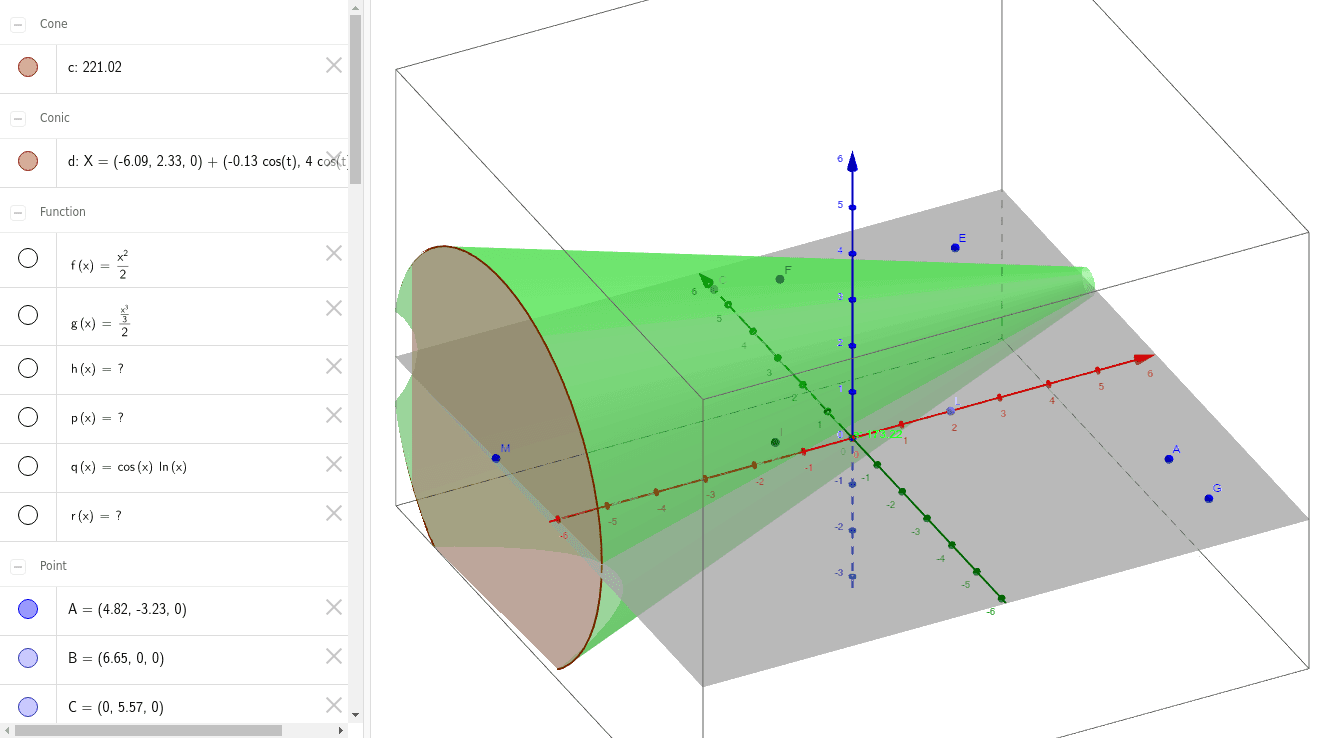
This GeoGebra example demonstrates the rotation of cones in three-dimensional space, allowing users to dynamically adjust rotation angles and observe changes in the cone's shape and related geometric elements. The core mathematical concepts involve solid geometry including cones, pyramids, and prisms, as well as rotation, ratios, cosine values, and median lines. The construction uses GeoGebra commands such as Point, Pyramid, Prism, Cone, and Integral, creating multiple vertices (A through L), faces (like faceABC, faceEFGH), and edges (like edgeBC, edgeEF) to build a complex composite of polyhedra and cones. It is suitable for high school or early college students to understand rotational properties of 3D shapes, cross-sections and projections of spatial solids, and to explore proportional and trigonometric relationships through dynamic interaction. This resource can serve as a classroom demonstration or a self-guided exploration tool for learners.
GeoGebra Commands & Parameters
Point(xAxis) → BPoint(yAxis) → CPyramid(B, C, A, D) → a, faceABC, edgeAD, faceBCD, faceACD, faceABD, edgeBC, edgeAC, edgeAB, edgeBD, edgeCDPoint(xAxis) → LPrism(E, F, G, H, L) → b, I, edgeEF, edgeFG, edgeGH, edgeEH, edgeEL, edgeFI, edgeGJ, edgeHK, edgeIL, edgeIJ, J, edgeJK, edgeKL, K, faceEFGH, faceEFIL, faceFGJI, faceGHKJ, faceEHKL, faceIJKLCone(M, N, 4) → c, d, eIntegral(x) → fIntegral(f, x) → gIntegral((cos(x) * log(x))) → hIntegral((cos(x) * log(x)), x) → pIntegral(q) → r
AI Drawing Prompt Reference
Create a 3D composite geometric figure consisting of a pyramid, a prism, and a cone. Start by placing two points on the coordinate axes, forming a tetrahedron with the origin, with a triangular base and an apex above. Then add a rectangular prism on another side, with a rectangular base and vertical sides, tilted in space. Next, include a cone with a circular base and a height of four, with its apex pointing sideways. Finally, draw several curves nearby: a basic curve, its integral, and integrals involving cosine and logarithmic functions, serving as auxiliary references to illustrate rotation and proportional relationships. Ensure the spatial arrangement clearly shows the connections between the solids and the curves.
The prompt above was compiled from the original drawing commands and is for reference only.