
Practice Linear Function Slope and Intercept from the Graph
Loading the math board and drawing, please wait…
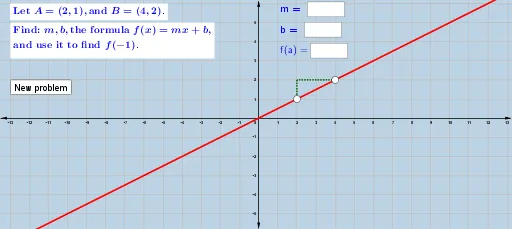
This example demonstrates how to read the slope m and the y-intercept b (the ordinate to the origin/vertical-axis intercept) from the graph of a linear function f(x)=mx+b. It focuses on the geometric meaning of slope as the ratio Δy/Δx, and on connecting the algebraic form with graph features. The GeoGebra construction uses Random to generate points that define a line, Line to draw the main line, OrthogonalLine and Intersect to construct right-angle references and intersection points, Segment to illustrate the rise/run used for computing Δy and Δx, and Distance to measure those changes. If and Textfield support interactive evaluation and user input, while Text labels display key values such as slope and ordinate and the resulting function information. Suitable for formative assessment and learning graph-to-equation interpretation in school math and early university calculus/analytic geometry prerequisites.
GeoGebra Commands & Parameters
Random(-5, 5) → x_1Random(-5, 5) → y_1Random(-5, 5) → y_2Random(-5, 5) → x_2Line(A, B) → lOrthogonalLine(A, xAxis) → gOrthogonalLine(B, yAxis) → hIntersect(g, h) → CSegment(B, C) → iSegment(C, A) → jDistance(A, C) → Δ_yDistance(B, C) → Δ_xIf(x_2 ≠ x_1, (y_2 - y_1) / (x_2 - x_1)) → mIf(x_2 ≠ x_1, y_1 - (m * x_1)) → bIf(x_2 ≠ x_1, (m * x) + b) → fTextfield(slope) → CasillaDeEntrada1Textfield(ordinate) → CasillaDeEntrada2Textfield(eval) → CasillaDeEntrada3Random(-5, 5) → aIf(slope ≟ m, "Right you are!", "Not quite, try again!") → texto2If(ordinate ≟ b, "Right you are!", "Not quite, try again!") → texto3If(eval ≟ f(a), "Right you are!", "Not quite, try again!") → texto4
AI Drawing Prompt Reference
Draw a graph of a linear function to show the slope and y-intercept. Include a line, the x-axis, and the y-axis. Add perpendicular lines from two points on the line to the y-axis. Label the slope, y-intercept, and function expression. Ensure the graph is clear and accurate for understanding the geometric meaning of linear functions.
The prompt above was compiled from the original drawing commands and is for reference only.