
Powers of Complex Numbers: Geometric Rotation and Scaling
Loading the math board and drawing, please wait…
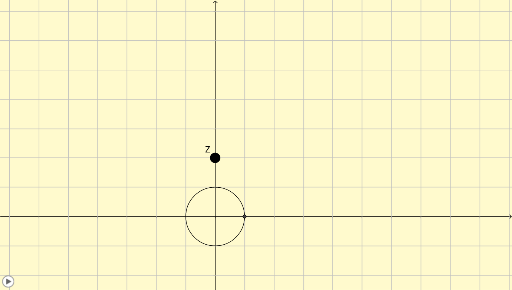
①This GeoGebra example dynamically demonstrates the geometric effect of raising a complex number z to a natural power n: the modulus is scaled by |z|^n and the argument is multiplied by n, with the unit circle, vectors, and the power point visualized. ②Core mathematical concepts include polar representation of complex numbers (ToPolar), the geometric meaning of complex multiplication (moduli multiply, arguments add), the rotation and scaling nature of powers, and the role of the integer exponent n. ③Construction highlights: using GeoGebra commands such as Intersect, Circle, Rotate, Angle, ToComplex, ToPolar, Vector, and Mirror to build the complex point, unit circle, rotating vectors, and the power point; a slider n controls the exponent, dynamically updating the power Zpower and displaying related angles, moduli, and text labels; objects include N, A, c, C, Nroot, α_1, u, v, α, NrootPower, w, z, β, Z, CZ, n, Zpower, ZI, ZC, ZCI, e, f, g, CZC, z_1, CZI, CZCI, z_2, z_3, b, d, text1, h, i, Zshow. ④Suitable for high school or early college students learning complex number operations and their geometric interpretation, and for teachers demonstrating or students exploring powers and roots of complex numbers.
GeoGebra Commands & Parameters
Intersect(xAxis, yAxis) → ACircle(A, 1) → cRotate(C, (360 / N)°, A) → NrootAngle(C, A, Nroot) → α_1ToComplex(Vector[Nroot]) → uToPolar(Vector[Nroot]) → vVector(NrootPower) → wToPolar(w) → zAngle(C, A, NrootPower) → βToComplex(w) → aToComplex(Vector[Z]) → CZMirror(Z, c) → ZIMirror(Z, xAxis) → ZCMirror(ZC, c) → ZCIToComplex(Vector[ZC]) → CZCToComplex(Vector[ZI]) → CZIToComplex(Vector[ZCI]) → CZCIVector(Zpower) → hVector(z_1) → jVector(z_2) → kVector(z_3show) → lVector(z_2show) → m