
Planetary Orbit Driven by Complex Number i: GeoGebra Parametric Animation
Loading the math board and drawing, please wait…
In collections
Complex Math
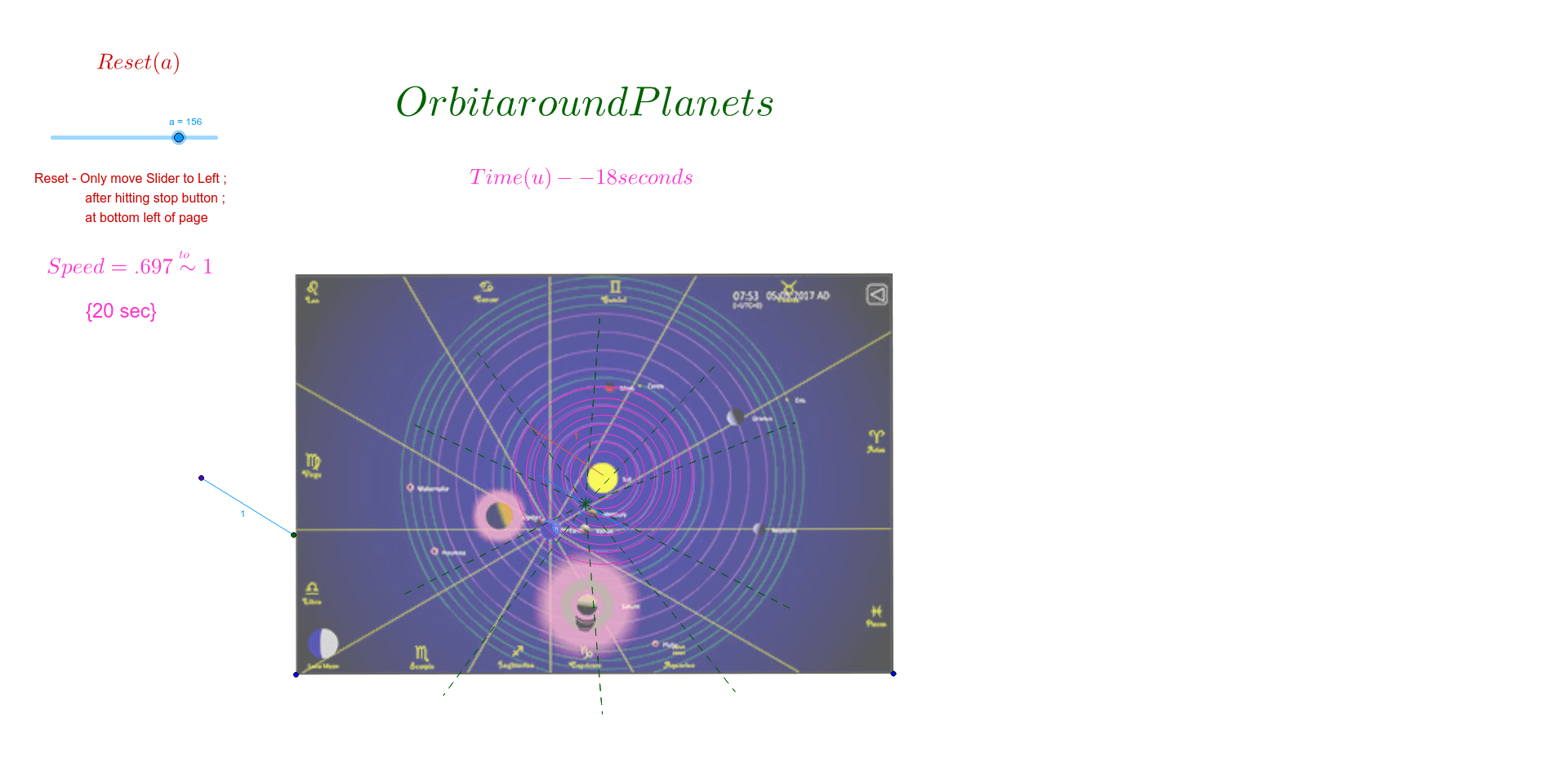
This GeoGebra example demonstrates a planetary orbit driven by the complex number i as a rotation operator. It visualizes how complex numbers can be used in parametric equations to model circular or elliptical orbits. Key mathematical concepts include complex number rotation, parametric curves, derivatives, and integrals. Construction highlights: Using commands Point, Vector, Circle, Translate, and Polygon to create the orbit path and calculate enclosed areas. Ideal for high school or college teaching of complex numbers and calculus visualization.
GeoGebra Commands & Parameters
Point(b) → APoint(c) → BSegment(C, A) → dSegment(C, B) → fPoint(c) → DSegment(B, D) → iPoint(Circle[A, 1.4142135623730951]) → FSegment(A, F) → gSegment(A, F) → hPolygon(B, C, D) → poly1, d_1, b_1, c_1Segment(C, D) → d_hPoint(c) → EPoint(c) → GSegment(B, G) → τSegment(F, G) → nSlope(n) → mSlope(d_h) → m_1Circle(C, A) → kArea(k) → ePointIn(k) → PointkLine(H, f) → jIntersect(k, j, 2) → ISegment(C, I) → lLine(I, b) → pIntersect(p, d) → JSegment(C, J) → qSegment(J, I) → sPoint(s) → KSegment(C, K) → tSegment(I, F) → a_1Segment(J, A) → e_1Polygon(C, I, F, G, B) → poly2, c_2, i_1, f_1, g_1, b_2Name(o) → A1Name(u) → B1Name(a) → C1Point(k) → LCircle(M, N) → h_1Point(h_1) → OPoint(h_1) → PMidpoint(O, P) → QSegment(M, O) → j_1Segment(z_1, z_2) → k_1Vector(T, U) → vTranslate(z_1, v) → z_3Translate(z_2, v) → z_4Segment(z_3, z_4) → l_1Point(l_1) → VSegment(V, W) → n_1Segment(V, Z) → p_1Segment(V, A_1) → q_1Segment(V, B_1) → r_1Segment(V, C_1) → s_1Segment(V, D_1) → t_1Segment(V, E_1) → a_2Segment(V, F_1) → d_2Segment(V, G_1) → e_2Point(j_1) → H_1Circle(H_1, I_1) → f_2Circle(H_1, J_1) → g_2Circle(H_1, K_1) → h_2Circle(H_1, L_1) → k_2Circle(H_1, M_1) → p_2Circle(H_1, N_1) → q_2Circle(H_1, O_1) → r_2Point(h_1) → P_1Circle(H_1, P_1) → s_2Segment(V, Q_1) → i_2
AI Drawing Prompt Reference
This is a planetary orbit driven by the complex number i, showing how complex number rotation generates circular or elliptical orbits. The graph includes a center point, an orbital path, a circular region, and intersection points between the orbit and the circle. Using parametric equations and rotation operations, the orbit appears as a circle or ellipse in geometry. The construction uses points, vectors, circles, and transformations to draw the orbital path and calculate enclosed areas. The graph illustrates the application of complex numbers in parametric curves, helping to understand rotation and integration concepts.
The prompt above was compiled from the original drawing commands and is for reference only.