
Plane Shapes Consolidation
Loading the math board and drawing, please wait…
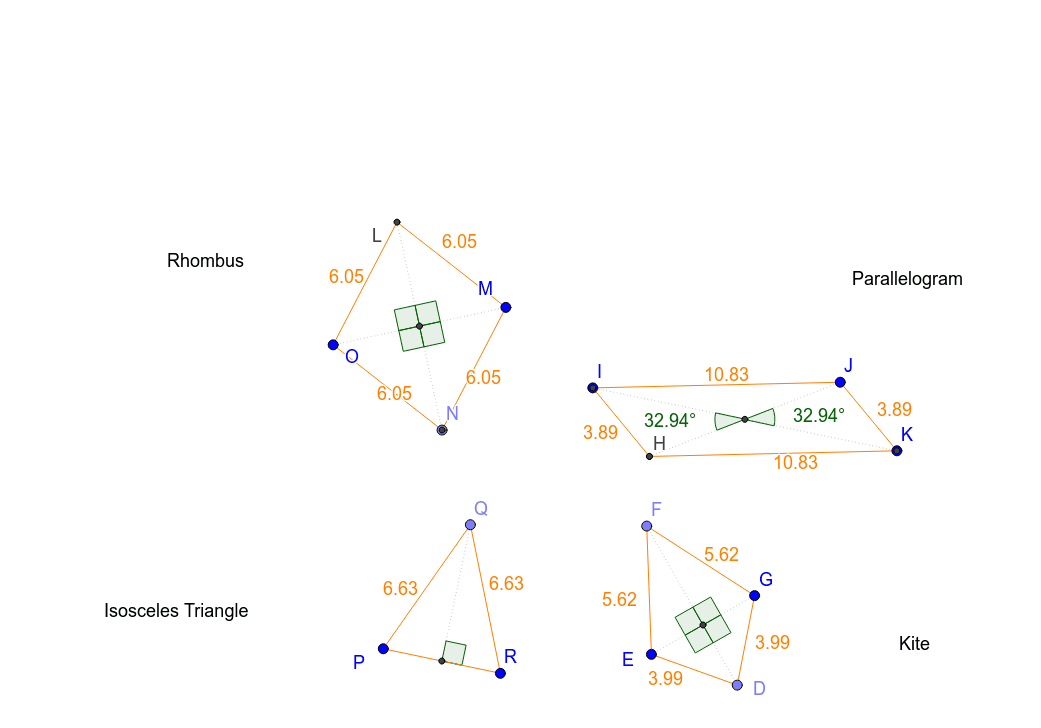
This example demonstrates geometric properties and calculations of plane shapes like kites, parallelograms, and rhombuses. It involves core concepts such as perimeter, area, angle bisectors, special points, and geometric constructions. GeoGebra commands and objects used include Segment, LineBisector, Point, Line, Intersect, Distance, Angle, and Circle. Suitable for middle school math geometry teaching and learning.
GeoGebra Commands & Parameters
Segment(P, R) → bLineBisector(b) → cPoint(c) → QSegment(Q, P) → dSegment(Q, R) → eLineBisector(G, E) → aPoint(a) → DPoint(a) → FSegment(D, G) → fSegment(G, F) → gSegment(F, E) → hSegment(D, E) → iSegment(G, E) → jSegment(D, F) → kSegment(I, J) → lSegment(J, K) → mLine(I, m) → nLine(K, l) → pIntersect(n, p) → HLineBisector(b) → qDistance(p, l) → oIntersect(n, p) → L_1Intersect(l, n) → M_1Intersect(m, p) → N_1Segment(H, K) → rSegment(H, I) → sSegment(I, K) → tSegment(H, J) → a_1Intersect(t, a_1) → BSegment(I, B) → b_1Segment(K, B) → c_1Segment(H, B) → d_1Segment(J, B) → e_1Angle(I, B, H) → αAngle(K, B, J) → βIntersect(j, k) → CSegment(E, C) → f_1Segment(F, C) → g_1Segment(D, C) → h_1Segment(C, G) → i_1Angle(G, C, F) → γAngle(F, C, E) → δAngle(E, C, D) → εAngle(D, C, G) → ζSegment(M, O) → j_1LineBisector(j_1) → k_1Point(k_1) → NCircle(M, N) → p_1Intersect(p_1, k_1) → P_1, LSegment(M, L) → l_1Segment(L, O) → m_1Segment(O, N) → n_1Segment(N, M) → q_1Intersect(k_1, j_1) → ASegment(N, A) → r_1Intersect(q, b) → YSegment(A, L) → t_1Segment(O, A) → a_2Segment(A, M) → b_2Segment(R, Y) → s_1Segment(Y, P) → c_2Segment(Y, Q) → d_2Angle(R, Y, Q) → ηAngle(M, A, L) → θAngle(N, A, M) → ιAngle(O, A, N) → κAngle(L, A, O) → λ
AI Drawing Prompt Reference
Draw a comprehensive plane figure exercise: start with a segment and its perpendicular bisector, place a point on the bisector, and connect it to the segment endpoints to form an isosceles triangle. Then construct another set of points and segments to form a kite and a rhombus, including their diagonals, angle bisectors, and intersection points. Next, draw a quadrilateral formed by several segments, mark the intersection of its diagonals, and measure relevant angles. Finally, construct a circle using a segment as radius, place a point on it, and complete the figure.
The prompt above was compiled from the original drawing commands and is for reference only.