
Perspective Ellipse Demo
Loading the math board and drawing, please wait…
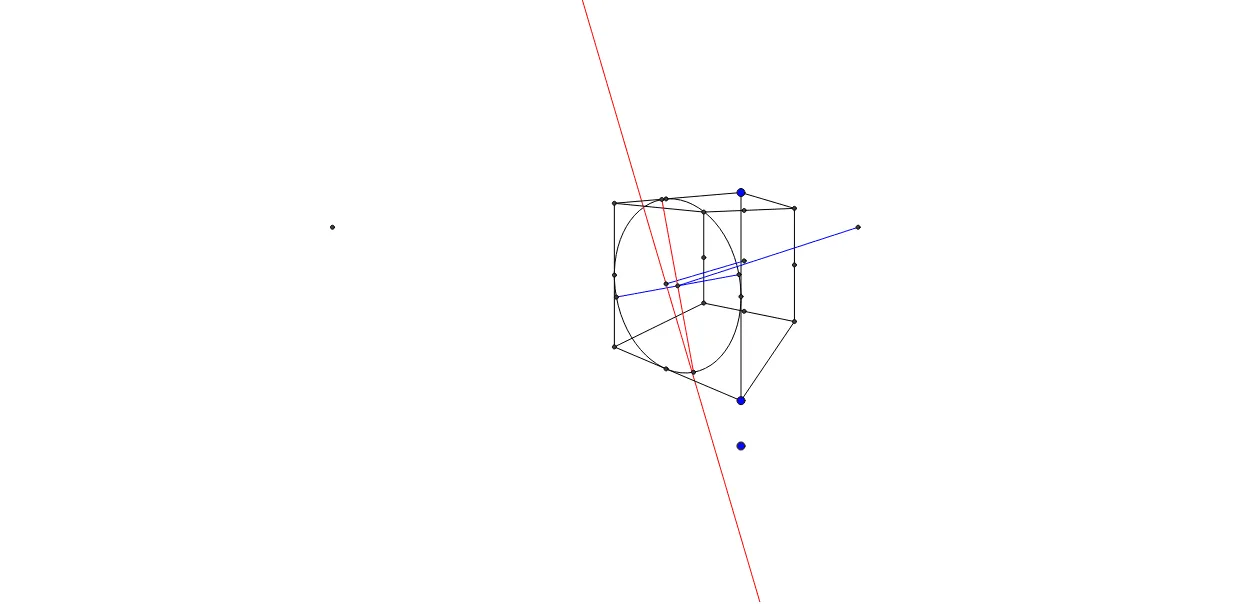
This example demonstrates the formation and properties of ellipses under perspective projection. It involves core mathematical concepts such as ellipses, perspective geometry, geometric mean, sine function, parametric curves, rhombuses, and probability statistics. The construction utilizes GeoGebra commands and objects like Intersect (intersection), Line (line), OrthogonalLine (perpendicular line), Point (point), Circle (circle), Segment (segment), Midpoint (midpoint), and Conic (conic). Suitable for high school and above learners to understand the integration of spatial geometry and analytical geometry.
GeoGebra Commands & Parameters
Intersect(xAxis, yAxis) → ALine(A, B) → aOrthogonalLine(B, a) → bIntersect(b, xAxis) → CLine(A, C) → cOrthogonalLine(B, c) → dPoint(d) → DLine(A, D) → eLine(D, C) → fCircle(C, B) → gCircle(A, B) → hIntersect(g, c, 1) → EIntersect(h, c, 2) → FPoint(d) → GOrthogonalLine(D, d) → iCircle(D, G) → kIntersect(k, i, 2) → HIntersect(k, i, 1) → ILine(I, E) → jLine(H, F) → lIntersect(e, l) → JIntersect(f, j) → KLine(J, d) → mLine(K, d) → nLine(A, G) → pLine(G, C) → qIntersect(m, p) → LIntersect(n, q) → MLine(M, A) → rLine(L, C) → sIntersect(r, s) → NLine(K, A) → tLine(J, C) → a_1Intersect(t, a_1) → OLine(D, L) → b_1Line(J, G) → c_1Intersect(b_1, c_1) → PLine(K, N) → d_1Line(O, M) → e_1Intersect(d_1, e_1) → QLine(P, A) → f_1Intersect(m, f_1) → RIntersect(d, f_1) → SLine(P, m) → g_1Line(Q, d) → h_1Intersect(t, h_1) → TIntersect(e, g_1) → UIntersect(p, g_1) → VIntersect(r, h_1) → WLine(O, N) → i_1Line(Q, A) → j_1Intersect(i_1, j_1) → ZIntersect(n, j_1) → A_1Segment(L, J) → k_1Segment(J, D) → l_1Segment(G, L) → m_1Segment(N, L) → n_1Segment(M, G) → p_1Segment(K, M) → q_1Segment(D, K) → r_1Segment(G, D) → s_1Segment(M, N) → t_1Segment(O, N) → a_2Segment(J, O) → b_2Segment(K, O) → c_2Segment(P, Q) → d_2Midpoint(S, V) → B_1Midpoint(R, U) → C_1Line(G, B_1) → e_2Line(J, C_1) → f_2Intersect(e_2, f_2) → D_1Point(l_1) → E_1Line(P, E_1) → g_2Line(U, S) → h_2Intersect(g_2, h_2) → F_1Line(V, F_1) → i_2Line(R, E_1) → j_2Intersect(i_2, j_2) → G_1Conic(R, U, G_1, S, V) → k_2Circle(J, D_1) → p_2Line(G, D_1) → l_2Line(J, D_1) → m_2Intersect(p_2, m_2, 2) → H_1Intersect(p_2, l_2, 2) → I_1Line(V, S) → n_2Line(R, U) → q_2Line(D_1, n_2) → r_2Line(D_1, q_2) → s_2Intersect(p_2, r_2, 2) → J_1Intersect(p_2, s_2, 2) → K_1Line(H_1, K_1) → t_2Line(J_1, I_1) → a_3Intersect(t_2, a_3) → L_1Line(L_1, J) → b_3Intersect(p_2, b_3, 2) → M_1Line(M_1, D_1) → c_3OrthogonalLine(D_1, c_3) → d_3Intersect(k_2, d_3, 1) → N_1Intersect(k_2, c_3, 2) → O_1Intersect(k_2, c_3, 1) → P_1Intersect(k_2, d_3, 2) → Q_1Segment(N_1, Q_1) → e_3Segment(O_1, P_1) → f_3Segment(D_1, C) → g_3OrthogonalLine(P, d_2) → h_3
AI Drawing Prompt Reference
Draw a demonstration of an ellipse under perspective projection, including two perpendicular line segments that intersect the coordinate axes at four points. Construct two more perpendicular line segments based on these points and draw two circles. Find the intersections of these circles with the line segments, then draw two line segments using these intersection points. Locate their intersection point. Finally, draw two more line segments using these intersection points and find their intersection point to form a closed ellipse.
The prompt above was compiled from the original drawing commands and is for reference only.