
Perpendicular Fitting
Loading the math board and drawing, please wait…
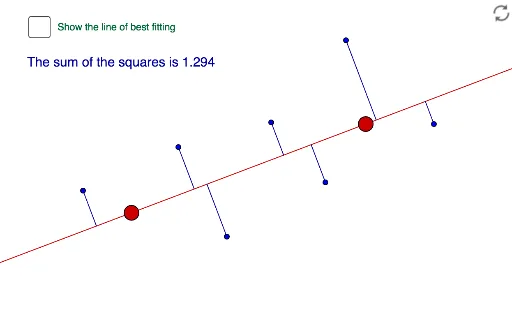
This example demonstrates the concept of perpendicular fitting. It involves key mathematical concepts such as lines, perpendicular lines, intersections, segments, and fitting lines. Using GeoGebra commands like Line, OrthogonalLine, Intersect, Segment, and FitLineY, the construction of perpendicular fitting is illustrated. Suitable for high school mathematics education and learning.
GeoGebra Commands & Parameters
Line(A, B) → aOrthogonalLine(C, a) → bOrthogonalLine(D, a) → cOrthogonalLine(E, a) → dOrthogonalLine(F, a) → eOrthogonalLine(G, a) → fOrthogonalLine(H, a) → gOrthogonalLine(I, a) → hIntersect(a, b) → JIntersect(a, c) → KIntersect(a, d) → LIntersect(a, e) → MIntersect(a, f) → NIntersect(a, g) → OIntersect(a, h) → PSegment(C, J) → iSegment(D, K) → jSegment(L, E) → kSegment(F, M) → lSegment(G, N) → mSegment(H, O) → nSegment(P, I) → pSum(L_2) → sumFitLineY(L_3) → qLine(Q, R) → rOrthogonalLine(C, xAxis) → sOrthogonalLine(E, xAxis) → tOrthogonalLine(D, xAxis) → a_1OrthogonalLine(F, xAxis) → b_1OrthogonalLine(G, xAxis) → c_1OrthogonalLine(H, xAxis) → d_1OrthogonalLine(I, xAxis) → e_1Intersect(r, s) → SIntersect(r, t) → TIntersect(r, a_1) → UIntersect(r, b_1) → VIntersect(r, c_1) → WIntersect(r, d_1) → ZIntersect(r, e_1) → A_1Segment(C, S) → f_1Segment(E, T) → g_1Segment(D, U) → h_1Segment(F, V) → i_1Segment(G, W) → j_1Segment(H, Z) → k_1Segment(I, A_1) → l_1Sum(L_5) → sum_2
AI Drawing Prompt Reference
Draw a line a on the coordinate system and find several lines b to h that are perpendicular to it. Then, find the intersections of these perpendicular lines with line a, labeled J to P. Connect points C, D, E, F, G, H, and I to these intersections to form several segments i to p. Next, find the sum of these segments as sum, and fit a best-fit line q. Finally, draw several lines perpendicular to the x-axis, labeled s to e_1, and find their intersections with the fitted line q, labeled S to A_1. Connect points C, E, D, F, G, H, and I to these intersections to form several segments f_1 to l_1, and find the sum of these segments as sum_2.
The prompt above was compiled from the original drawing commands and is for reference only.