
Perpendicular Bisector Theorem
Loading the math board and drawing, please wait…
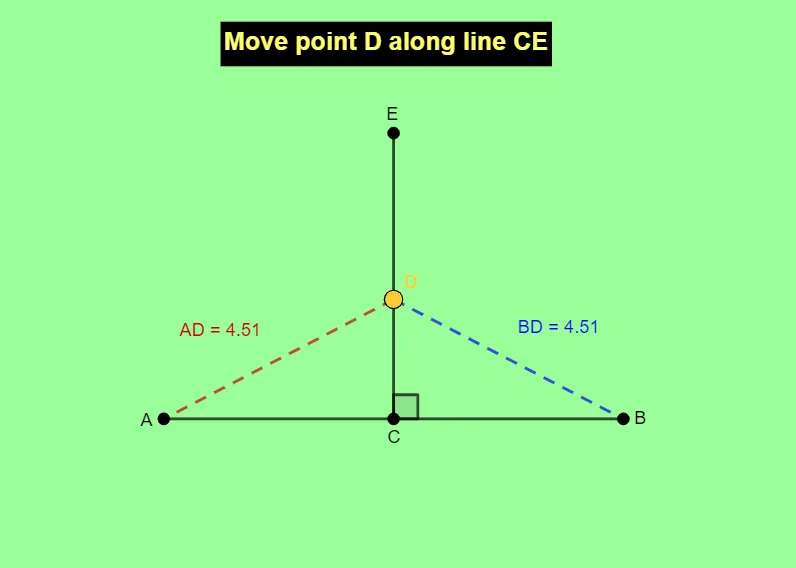
This example demonstrates the Perpendicular Bisector Theorem, which states that any point on the perpendicular bisector of a line segment is equidistant from the endpoints of the segment. Key concepts include the perpendicular bisector and the equidistant property. Using GeoGebra commands such as Segment, Point, and Angle, the perpendicular bisector of line segment AB is constructed and the theorem is verified. Suitable for middle school geometry education.
GeoGebra Commands & Parameters
Segment(A, B) → fPoint(f) → CSegment(C, E) → gAngle(B, C, E) → αPoint(g) → DSegment(D, A) → ADSegment(D, B) → BD
AI Drawing Prompt Reference
Draw a plane figure starting with a given segment AB, and construct its perpendicular bisector. Choose a point C on this perpendicular bisector so that the setup can illustrate that C is equidistant from A and B. Pick an auxiliary point E along the same perpendicular bisector direction, then draw the segment CE. At vertex C, construct an angle α using points B, C, and E. Mark another point D on the line through C and E, and finally draw segments AD and BD to represent the distances from D to the endpoints A and B for points lying on the perpendicular bisector.
The prompt above was compiled from the original drawing commands and is for reference only.