
Perimeter and Area of Regular Polygons
Loading the math board and drawing, please wait…
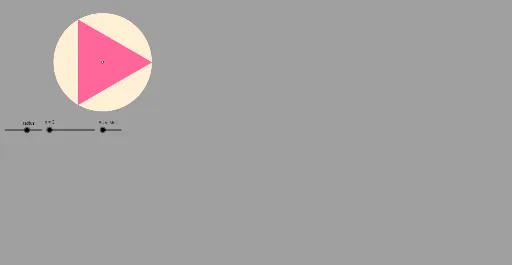
This example demonstrates the calculation of the perimeter and area of regular polygons. Key mathematical concepts include polygons, rotation, similar triangles, and isosceles triangles. Using GeoGebra commands such as Sequence, Polygon, and Center, dynamic construction of regular polygons and observation of their properties are achieved. Suitable for students at the junior high school level and above to learn about polygon-related knowledge.
GeoGebra Commands & Parameters
Sequence(((r * cos(((2 * π) * i / n))), (r * sin(((2 * π) * i / n)))), i, 0, n, 1) → list1Polygon(Element[list1, 1], Element[list1, 2], n) → poly1Center(c) → ASequence(CircleArc[A, Element[list1, i], Element[list1, i + 1]], i, 1, n, 1) → list2Sequence(Dilate[A, If[0 < a ≤ 1, 1 - a, 0], Element[list1, i]], i, 1, n, 1) → list3Sequence(Segment[A, Element[list3, i]], i, 1, n, 1) → list4
AI Drawing Prompt Reference
Draw a regular polygon by first generating n vertices through rotation, then forming the polygon with these vertices. Find the center of the polygon and draw n arcs around the center, each connecting two adjacent vertices. Finally, shrink each arc around the center to form n line segments, which will align with the polygon's sides.
The prompt above was compiled from the original drawing commands and is for reference only.