
Perimeter and Area in Similar Polygons
Loading the math board and drawing, please wait…
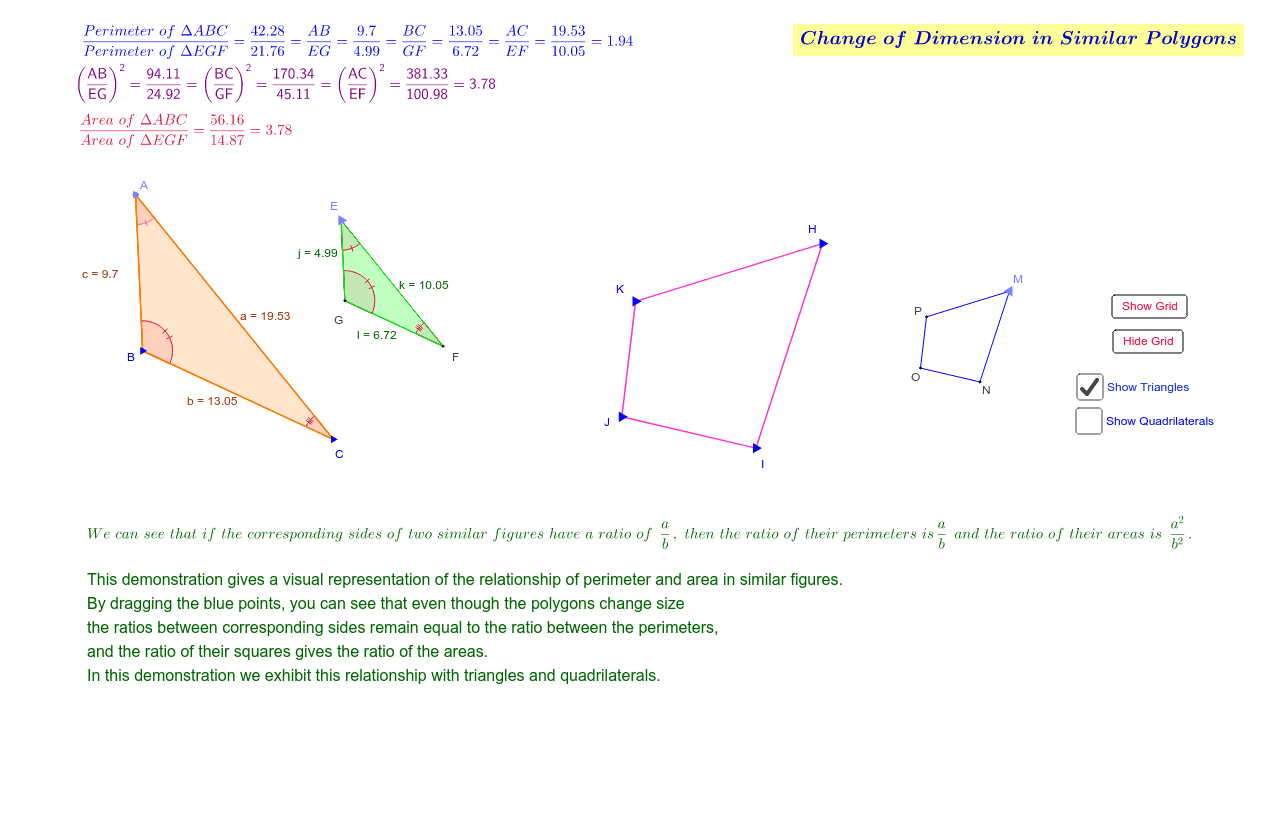
This example demonstrates the relationship between the perimeter and area of similar polygons. Key math concepts include similar polygons, perimeter, area, geometric mean, and quadratic equations. It is constructed using GeoGebra commands like Segment, Polygon, Line, Point, Intersect, Angle, PointIn, and Perimeter. Suitable for high school mathematics education to understand the proportional properties of similar polygons.
GeoGebra Commands & Parameters
Segment(A, C) → aSegment(C, B) → bSegment(B, A) → cPolygon(A, C, B) → ABC, b_1, a_1, c_1Line(A, D) → dLine(C, D) → eLine(B, D) → fPoint(d) → ELine(E, c) → gLine(E, a) → hIntersect(e, h) → FLine(F, b) → iIntersect(f, g) → GSegment(G, E) → jSegment(E, F) → kSegment(F, G) → lPolygon(G, E, F) → EGF, f_1, g_1, e_1Angle(B, A, C) → αAngle(A, C, B) → βAngle(A, B, C) → γAngle(G, E, F) → δAngle(E, F, G) → εAngle(F, G, E) → ζPointIn(ABC) → Pointpoly1_1PointIn(EGF) → Pointpoly2_1PointIn(EGF) → Pointpoly2_2Segment(H, I) → mSegment(J, I) → nSegment(H, K) → qSegment(J, K) → tLine(K, L) → d_1Line(H, L) → h_1Line(J, L) → i_1Line(I, L) → j_1Polygon(H, I, J, K) → poly1, h_2, i_2, j_2, k_1Point(h_1) → MLine(M, m) → l_1Line(M, q) → m_1Intersect(j_1, l_1) → NLine(N, n) → n_1Intersect(i_1, n_1) → OLine(O, t) → p_1Intersect(d_1, m_1) → PPolygon(N, M, P, O) → poly2, n_2, m_2, p_2, oAngle(N, M, P) → ηAngle(K, H, I) → θAngle(P, O, N) → ιAngle(K, J, I) → κAngle(H, K, J) → λAngle(H, I, J) → νAngle(M, N, O) → ξAngle(M, P, O) → οPointIn(poly1) → Pointpoly1_2PointIn(poly2) → Pointpoly2_3PointIn(poly1) → Pointpoly1_3Perimeter(ABC) → uPointIn(poly1) → Pointpoly1PointIn(poly2) → Pointpoly2Segment(P, M) → q_1Segment(M, N) → r_1Segment(N, O) → s_1Segment(O, P) → t_1