
Perigal Pythagorean Using Dilations And Vectors
Loading the math board and drawing, please wait…
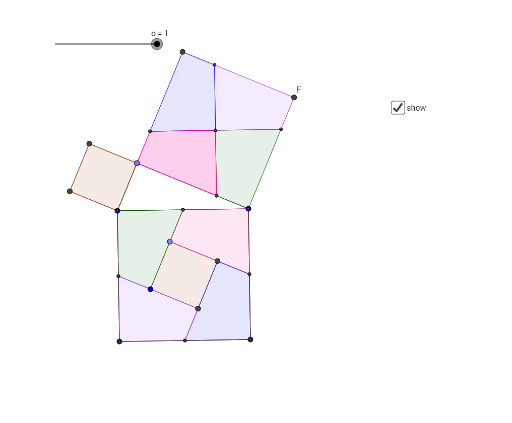
This example dynamically demonstrates the Perigal Pythagorean Theorem, revealing the geometric intuition behind the area relationships of three squares. It involves core mathematical concepts such as dilation transformations, vector operations, special point construction, and coordinate geometry. The construction utilizes GeoGebra commands and objects like segments, semicircles, points, polygons, midpoints, lines, intersections, dilations, vectors, and translations. Suitable for high school and above learners to understand the application of transformations and vectors in geometric proofs.
GeoGebra Commands & Parameters
Segment(A, B) → fSemicircle(A, B) → cPoint(c) → CSegment(A, C) → gSegment(C, B) → hPolygon(A, C, 4) → poly1, i, j, k, l, D, EPolygon(C, B, 4) → poly2, m, n, p, q, F, GPolygon(B, A, 4) → poly3, r, s, t, a, H, ISegment(G, B) → bMidpoint(b) → JLine(J, a) → dLine(J, f) → eIntersect(e, q) → KIntersect(d, p) → LIntersect(n, e) → MIntersect(d, h) → NPolygon(C, K, J, N) → poly4, c_1, k_1, j_1, n_1Polygon(N, J, M, B) → poly5, n_2, j_2, m_1, b_1Polygon(F, M, J, L) → poly6, f_1, m_2, j_3, l_1Polygon(G, L, J, K) → poly7, g_1, l_2, j_4, k_2Segment(J, A) → h_1Segment(J, B) → i_1Segment(J, H) → p_1Segment(J, I) → q_1Dilate(A, o, J) → A'Dilate(B, o, J) → B'Dilate(H, o, J) → H'Dilate(I, o, J) → I'Vector(J, A') → uVector(J, B') → vVector(J, I') → wVector(J, H') → u_1Translate(C, v_1) → C'Translate(K, v_1) → K'Translate(J, v_1) → J'Translate(N, v_1) → N'Polygon(C', K', J', N') → poly4', c', k', j', n'Translate(C', v) → C''Translate(K', v) → K''Translate(J', v) → J''Translate(N', v) → N''Polygon(C'', K'', J'', N'') → poly4'', c'', k'', j'', n''Translate(N, u) → N'_1Translate(J, u) → J'_1Translate(M, u) → M'Translate(B, u) → B'_1Polygon(N'_1, J'_1, M', B'_1) → poly5', n'_1, j'_1, m', b'_1Translate(G, w) → G'Translate(L, w) → L'Translate(J, w) → J'_2Translate(K, w) → K'_1Polygon(G', L', J'_2, K'_1) → poly7', g', l', j'_2, k'_1Translate(F, u_1) → F'Translate(M, u_1) → M'_1Translate(J, u_1) → J'_3Translate(L, u_1) → L'_1Polygon(F', M'_1, J'_3, L'_1) → poly6', f', m'_1, j'_3, l'_1Segment(A, I) → r_1Midpoint(r_1) → OSegment(D, A) → s_1Midpoint(s_1) → PSegment(P, O) → t_1Dilate(O, o, P) → O'Vector(P, O') → w_1Translate(poly1, w_1) → poly1'Segment(A, H) → a_1Segment(H, I) → d_1Segment(I, B) → e_1