
Pentominoes Construction
Loading the math board and drawing, please wait…
In collections
Elementary Geometry
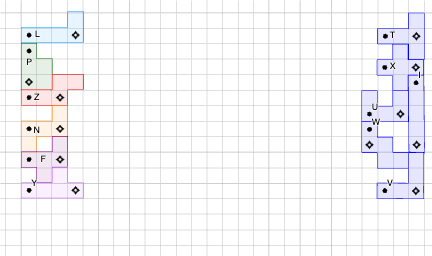
This example demonstrates the construction of pentominoes. It involves concepts of geometric construction and transformation. Using GeoGebra commands such as Point, OrthogonalVector, and Polygon, the dynamic display of symmetry and tiling of pentominoes is shown. Suitable for middle and high school students learning geometry and transformation.
GeoGebra Commands & Parameters
Point(Circle[L, an]) → A'OrthogonalVector(a) → a'Polygon(L - a - a', L - a + a', A' - a + a', A' - a + (3 * a'), A' + a + (3 * a'), A' + a - a') → poly1, f_3, g_3, h_4, i_4, j_4, k_5Mirror(poly1, Line[L, A']) → poly1'Mirror(poly1', Line[L, A']) → poly1''ptnv(P, 2) → B', b, b'Polygon(P - b - b', P - b + b', B' - (3 * b) + b', B' - (3 * b) + (3 * b'), B' + b + (3 * b'), B' + b - b') → poly2, l_5, m, n, p, q, rMirror(poly2, Line[P, B']) → poly2'Mirror(poly2', Line[P, B']) → poly2''ptnv(Z, 2) → C', c, c'Polygon(Z - c - c', Z - c + c', C' - c + c', C' - c + (3 * c'), C' + (3 * c) + (3 * c'), C' + (3 * c) + c', C' + c + c', C' + c - c') → poly3, s, t, d_1, e_1, f_1, g_1, h_1, i_1Mirror(poly3, Line[Z, C']) → poly3'Mirror(poly3', Line[Z, C']) → poly3''ptnv(N, 2) → D', d, d'Polygon(N - d - (3 * d'), N - d + d', D' - d + d', D' - d + (3 * d'), D' + d + (3 * d'), D' + d - d', N + d - d', N + d - (3 * d')) → poly4, j_1, k_1, l_1, m_1, n_1, p_1, q_1, r_1Mirror(poly4, Line[N, D']) → poly4'Mirror(poly4', Line[N, D']) → poly4''ptnv(F, 2) → E', e, e'Polygon(F - e - e', F - e + e', E' - e + e', E' - e + (3 * e'), E' + e + (3 * e'), E' + e - e', E' - e - e', E' - e - (3 * e'), F + e - (3 * e'), F + e - e') → poly5, s_1, j_2, t_1, a_1, b_1, c_1, f_2, g_2, h_2, i_2Mirror(poly5, Line[F, E']) → poly5'Mirror(poly5', Line[F, E']) → poly5''ptnv(Y, 3) → F', f, f'Polygon(Y - f - f', Y - f + f', F' - (3 * f) + f', F' - (3 * f) + (3 * f'), F' - f + (3 * f'), F' - f + f', F' + f + f', F' + f - f') → poly6, k_2, l_2, m_2, n_2, p_2, q_2, r_2, s_2Mirror(poly6, Line[Y, F']) → poly6'Mirror(poly6', Line[Y, F']) → poly6''ptnv(T, 2) → G', g, g'Polygon(T - g - g', T - g + g', G' - g + g', G' - g + (3 * g'), G' + g + (3 * g'), G' + g - (3 * g'), G' - g - (3 * g'), G' - g - g') → poly7, t_2, a_2, b_2, c_2, d_2, e_2, h_3, i_3ptnv(X, 2) → H', h, h'Polygon(X - h - h', X - h + h', X + h - (3 * h'), X + h - h', H' - (3 * h) + h', H' - (3 * h) + (3 * h'), H' - h + (3 * h'), H' - h + h', H' + h + h', H' + h - h', H' - h - h', H' - h - (3 * h')) → poly8, j_3, t_3, a_3, b_3, k_3, l_3, m_3, n_3, p_3, q_3, r_3, s_3ptnv(I, 4) → I', i, i'Polygon(I - i + i', I' + i + i', I' + i - i', I - i - i') → poly9, c_3, d_3, e_3, f_4ptnv(U, 2) → J', j, j'Polygon(U - j - j', U - j + (3 * j'), U + j + (3 * j'), U + j + j', J' - j + j', J' - j + (3 * j'), J' + j + (3 * j'), J' + j - j') → poly10, g_4, k_4, l_4, m_4, n_4, p_4, q_4, r_4ptnv(W, 1) → K', k, k'Polygon(W - k - k', W - k + k', W + k + k', W + k + (3 * k'), W + (3 * k) + (3 * k'), W + (3 * k) + (5 * k'), W + (5 * k) + (5 * k'), W + (5 * k) + k', W + (3 * k) + k', W + (3 * k) - k') → poly11, s_4, h_5, t_4, a_4, b_4, c_4, d_4, e_4, f_5, g_5ptnv(V, 2) → L', l, l'Polygon(V - l - l', V - l + l', L' - l + l', L' - l + (5 * l'), L' + l + (5 * l'), L' + l - l') → poly12, i_5, j_5, m_5, n_5, p_5, q_5
AI Drawing Prompt Reference
Draw five distinct shapes, each composed of connected line segments, to demonstrate the construction and symmetry of pentominoes. Start by creating a base pentagon, then generate the other four shapes through mirror and rotation operations, maintaining similarity with the base shape. The final image should display a complex pattern of interconnected pentomino modules.
The prompt above was compiled from the original drawing commands and is for reference only.