
Pentagon Angles Demo
Loading the math board and drawing, please wait…
In collections
geometriadinamica.es
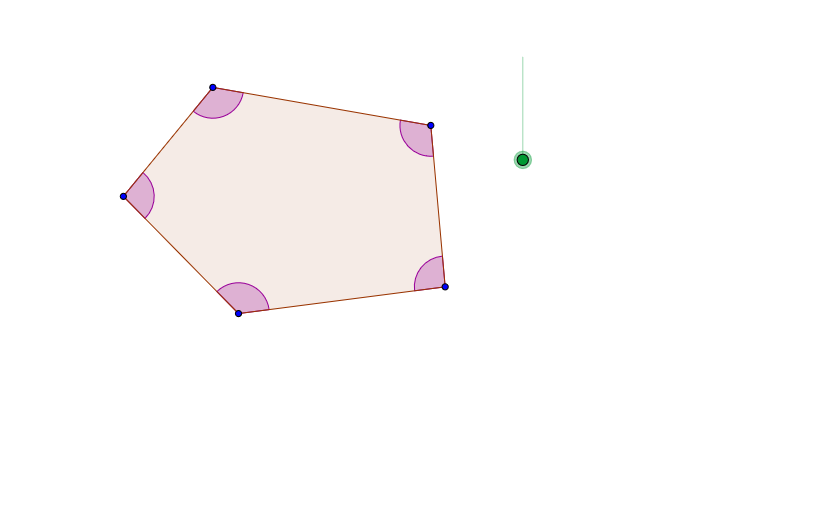
This example demonstrates the sum of interior and exterior angles of a pentagon. Key math concepts include the polygon angle sum theorem, exterior angle theorem, and angle measurement. Construction involves commands like Dilate, Mirror, Polygon, Angle, and Segment in GeoGebra to build and measure the angles. Suitable for middle school students and above for learning polygon geometry or classroom demonstrations.
GeoGebra Commands & Parameters
Dilate(C, d, F) → C'Dilate(B, d, F) → B'Mirror(C', B') → KDilate(A, d, F) → A'Polygon(A, B, C, D, E) → P, a, b, c, d_1, eAngle(C, B, A) → ζAngle(D, C, B) → ηAngle(E, D, C) → θAngle(A, E, D) → ιAngle(B, A, E) → κAngle((dd * B), (dd * A), (dd * G)) → αAngle((dd * H), (dd * A), (dd * E)) → γAngle((dd * G), (dd * C), (dd * B)) → δAngle((dd * G), (dd * C), (dd * D)) → εAngle((dd * H), (dd * D), (dd * E)) → λAngle((dd * H), (dd * D), (dd * C)) → μAngle((dd * G), (dd * A), (dd * H)) → βSegment(A, G) → fSegment(A, H) → gAngle((dd * A), (dd * B), (dd * C)) → νAngle((dd * A), (dd * E), (dd * D)) → ξ
AI Drawing Prompt Reference
Draw a pentagon and demonstrate the sum of its interior and exterior angles. Start by constructing five vertices and connecting them to form a closed polygon. Then, create auxiliary points outside the pentagon through scaling and reflection to construct exterior angles. Label all five interior angles and five exterior angles, each formed by extending adjacent sides. Finally, add two segments from a common vertex to clarify the relationship between interior and exterior angles. The figure should include all angle markings and visually show that the interior angles sum to 540 degrees and the exterior angles sum to 360 degrees.
The prompt above was compiled from the original drawing commands and is for reference only.