
Parametric Exponential Decay Family f(x)=a(1-e^(-bx))+c
Loading the math board and drawing, please wait…
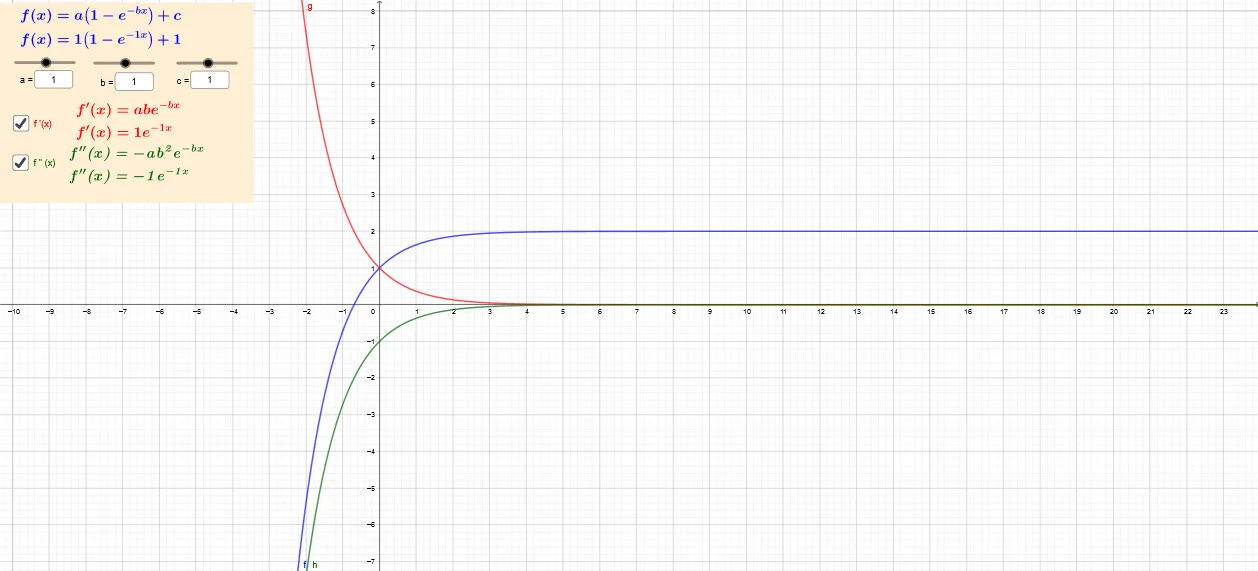
This GeoGebra example dynamically explores the family of exponential decay functions defined by f(x)=a(1-e^(-bx))+c, where parameters a, b, and c control the vertical scaling, decay rate, and vertical shift respectively. The core mathematical concepts include exponential functions, function transformations (translation and scaling), and the effect of parameters on the graph's shape and position. The construction uses Textfield objects to create input boxes (InputBox1, InputBox2, InputBox3) for adjusting a, b, and c, along with the function f for plotting. Additional objects such as g, h, d, text2, e, i, text3, text5, j, k, and text4 are included for labeling or auxiliary analysis. This resource is suitable for high school or early college students to understand exponential decay models, parameter sensitivity, and to support discussions on asymptotes and rates of change in calculus.
GeoGebra Commands & Parameters
Textfield(a) → InputBox1Textfield(b) → InputBox2Textfield(c) → InputBox3
AI Drawing Prompt Reference
Create a dynamic graph showing the family of exponential decay functions f(x)=a(1-e^(-bx))+c, with sliders for parameters a, b, and c, and the function plot. Adjust the sliders to see how the function graph changes, and label the parameters and function expression with text annotations to analyze their effects on the graph.
The prompt above was compiled from the original drawing commands and is for reference only.