
Parametric Equation of a Plane in Space
Loading the math board and drawing, please wait…
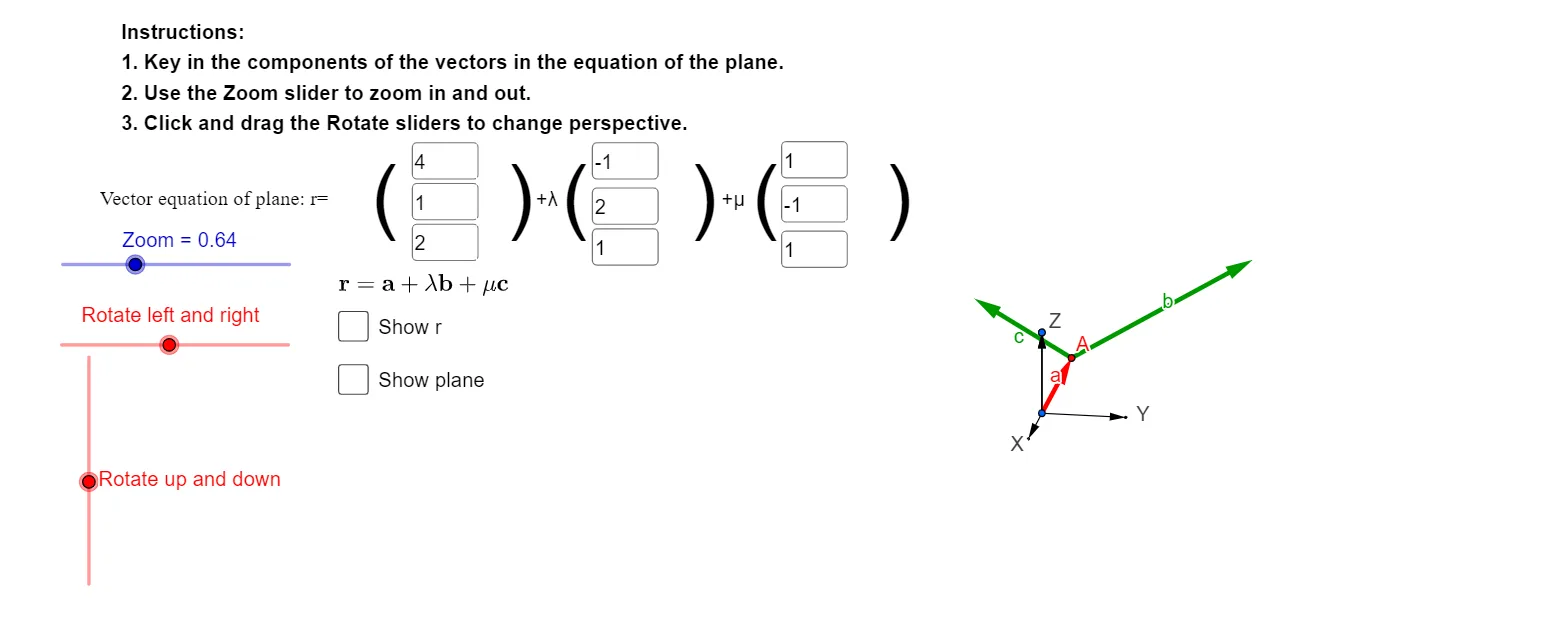
This example explores the parametric equation of a plane in space. Key mathematical concepts include vectors and coordinate geometry. Using GeoGebra commands such as Vector, Rotate, and Translate, the parametric equation of a plane can be constructed. Suitable for high school mathematics education and learning.
GeoGebra Commands & Parameters
Vector(O, X) → iVector(O, Z) → kOrthogonalLine(Rotate, yAxis) → a_1OrthogonalLine(Rotate, xAxis) → b_1Vector(O, Y) → jTextfield(a_x) → inputBox1Textfield(a_y) → inputBox2Textfield(a_z) → inputBox3Textfield(b_x) → inputBox4Textfield(b_y) → inputBox5Textfield(b_z) → inputBox6Textfield(c_x) → inputBox7Textfield(c_y) → inputBox8Textfield(c_z) → inputBox9Vector(O, A) → aVector(A, B) → bVector(A, C) → cVector(A, B_1) → λbVector(B_1, P) → μcVector(O, Bunit) → bunitVector(O, Cunit) → cunitPolygon(K, L, M, N) → poly1, k_1, l, m, nVector(O, P) → rTranslate(O, k) → O'Vector(O, O') → uTranslate(O, k) → O'_1Vector(O, O'_1) → v
AI Drawing Prompt Reference
Draw a plane in 3D space defined by a point and two direction vectors. Start with a 3D coordinate system showing the origin and axes. From the origin, draw three unit vectors along the x, y, and z axes. Then choose a point A in space, and from A draw two non-parallel direction vectors. Use sliders to scale these two vectors, creating two moving points on the plane. Connect these points with A to form a parallelogram, and draw a vector from the origin to a point on this parallelogram, representing the parametric equation of the plane. Add input boxes on the axes to adjust the components of the direction vectors.
The prompt above was compiled from the original drawing commands and is for reference only.