
Parallelograms Practice
Loading the math board and drawing, please wait…
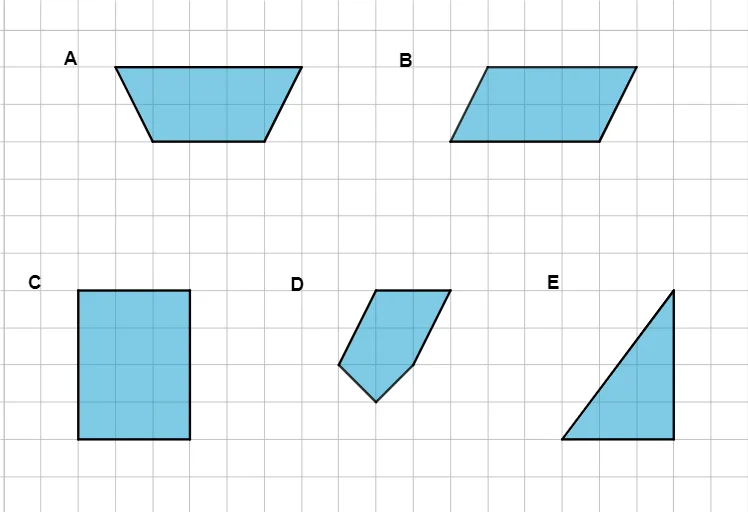
This example demonstrates the construction and properties of parallelograms. It involves core mathematical concepts such as parallel lines, vectors, diagonals, symmetry, and congruence. The construction uses commands like Polygon to create shapes like polyC, polyA, polyB, polyD, polyE, along with objects f, g, h, i, j, k, l, m, n, p, q, r, s, t, a, b, c, d, e, f_1. It is suitable for middle school and above students to learn and understand the geometric properties of parallelograms.
GeoGebra Commands & Parameters
Polygon((0, 0), (3, 0), (3, 4), (0, 4)) → polyC, f, g, h, iPolygon((2, 8), (5, 8), (6, 10), (1, 10)) → polyA, j, k, l, mPolygon((10, 8), (14, 8), (15, 10), (11, 10)) → polyB, n, p, q, rPolygon((7, 2), (8, 1), (9, 2), (10, 4), (8, 4)) → polyD, s, t, a, b, cPolygon((13, 0), (16, 0), (16, 4)) → polyE, d, e, f_1
AI Drawing Prompt Reference
Draw a practice scene with multiple geometric shapes focusing on parallelogram properties. Start with a rectangle whose vertices are at the origin, a point to the right, a point above, and a point to the upper left, forming a closed quadrilateral. Then add two slanted parallelograms, one in the upper left area and one in the upper right, with opposite sides parallel and equal. Next, draw an irregular quadrilateral with vertices at (7,2), (8,1), (9,2), (10,4), and (8,4), noting it is not a parallelogram. Finally, include a right triangle with a horizontal base and a right angle at the lower right. Ensure all shapes have clear sides and angles for observing parallelism, symmetry, and diagonal relationships.
The prompt above was compiled from the original drawing commands and is for reference only.