
Parallelogram with Measurements
Loading the math board and drawing, please wait…
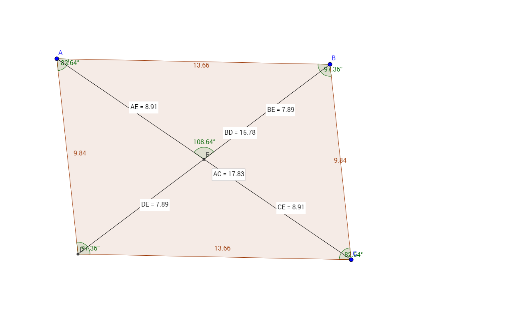
This GeoGebra example demonstrates a parallelogram with comprehensive measurements, including side lengths, diagonal lengths, angles, and distances from vertices to the intersection point of diagonals. The core mathematical concepts involve properties of parallelograms such as opposite sides parallel and equal, diagonals bisecting each other, and quantitative analysis using distance and angle tools. Construction details: using GeoGebra commands like Segment, Line, Intersect, Polygon, Angle, Distance, and Midpoint, the example constructs vertices A, B, C, D, sides f, g, h, i, diagonals AC and BD, midpoint E, and measures side lengths, diagonal lengths, distances from vertices to E, and angles α, β, γ, δ. Suitable for middle or high school geometry classes to visually explore measurement relationships in parallelograms, and can serve as a starting point for dynamic investigations.
GeoGebra Commands & Parameters
Segment(A, B) → fSegment(B, C) → gLine(A, g) → hLine(C, f) → iIntersect(h, i) → DPolygon(A, B, C, D) → poly1, a, b, c, dSegment(A, C) → jSegment(B, D) → kIntersect(j, k) → EAngle(C, D, A) → αAngle(D, A, B) → βAngle(A, B, C) → γAngle(B, C, D) → δDistance(b, a) → eDistance(A, E) → distanceAEMidpoint(A, E) →Distance(B, E) → distanceBEMidpoint(B, E) →Distance(C, E) → distanceCEMidpoint(C, E) →Distance(D, E) → distanceDEMidpoint(D, E) →Angle(B, E, A) → εDistance(A, C) → distanceACMidpoint(A, C) →Distance(B, D) → distanceBDMidpoint(B, D) →