
Parallelogram Proof
Loading the math board and drawing, please wait…
In collections
Area of Polygons
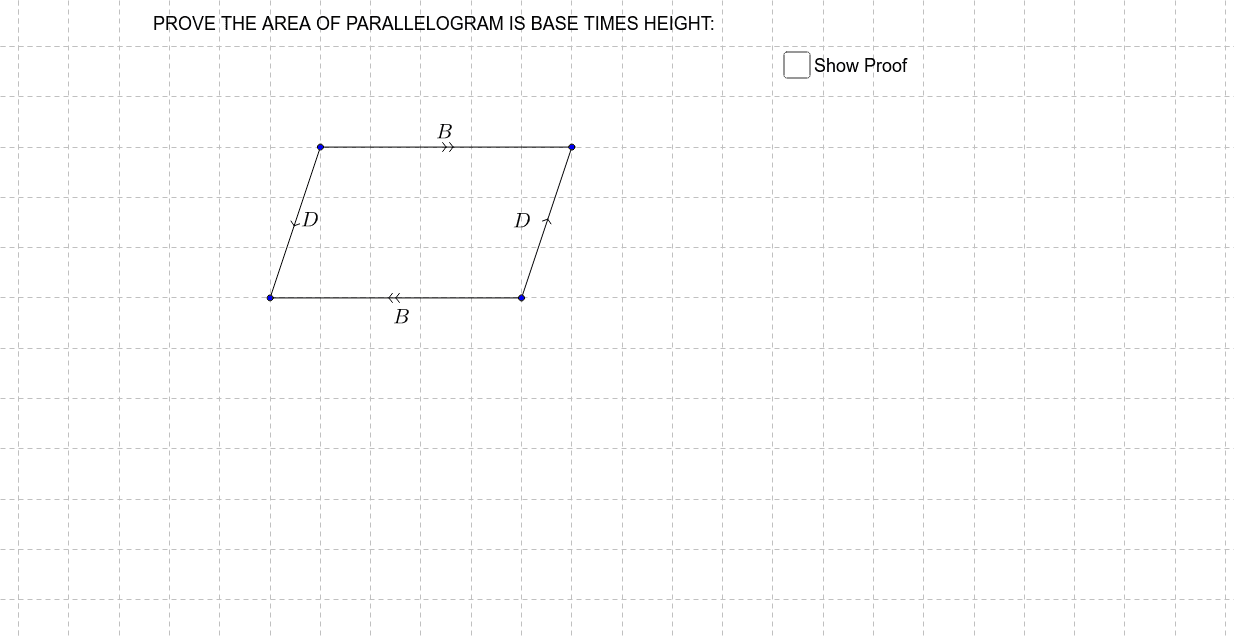
This example demonstrates the proof of a parallelogram. Key mathematical concepts include vectors, angles, and ratios. Using GeoGebra commands such as Segment and Angle, a parallelogram is constructed and its properties are illustrated through geometric construction. Suitable for students at the middle school level and above.
GeoGebra Commands & Parameters
Segment(A_1, B) → aSegment(A_1, C) → bSegment(D, B) → cSegment(D, C) → dAngle(A_1, C, D) → αAngle(D, B, A_1) → βAngle(B, A_1, C) → γAngle(C, D, B) → ASegment(F, B) → eSegment(F, A_1) → fSegment(C, E) → gSegment(D, E) → hAngle(E, D, C) → εAngle(F, A_1, B) → ζ
AI Drawing Prompt Reference
Draw a parallelogram ABCD, connect point A to point C to form side AC, and connect point D to point B to form side DB. Construct angles A1CD, DAB1, BCA1, and CDB. Then, draw point F, connect point F to point B, and point F to point A1. Connect point C to point E and point D to point E. Construct angles EDC and A1FB.
The prompt above was compiled from the original drawing commands and is for reference only.