
Parallelogram Problem with Ellipse, Rotation, and Standard Deviation
Loading the math board and drawing, please wait…
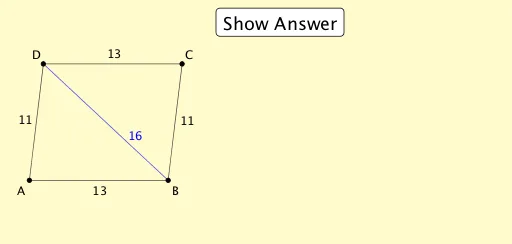
①This example demonstrates a dynamic geometry problem centered on a parallelogram, integrating an ellipse, rotation, and standard deviation to explore relationships through interactive controls and text output. ②Core mathematical concepts include properties of parallelograms, ellipse geometry, rotational transformations, standard deviation (a statistical measure), and tangent functions with function graphs, highlighting the intersection of algebra and geometry. ③Construction details: Based on the construction summary, GeoGebra commands such as Intersect, Point, Circle, Polygon, and Segment are used, creating objects like points A, B, C, D, E, F; circles c and d; polygon q1; segments a, b, d_1, c_1; functions f and g; a button (button1) and text (text1) for dynamic interaction and result display. ④This is suitable for high school or college-level mathematics instruction, useful for exploring integrated problems in analytic geometry, statistics, and functions, and can serve as a teacher demonstration or student self-exploration material.
GeoGebra Commands & Parameters
Intersect(xAxis, yAxis) → APoint(xAxis) → BCircle(A, 11) → cCircle(B, 16) → dIntersect(c, d, 1) → DPolygon(A, B, C, D) → q1, a, b, d_1, c_1Segment(D, B) → fSegment(C, A) → g