
Parallelogram Exploration by atreitman
Loading the math board and drawing, please wait…
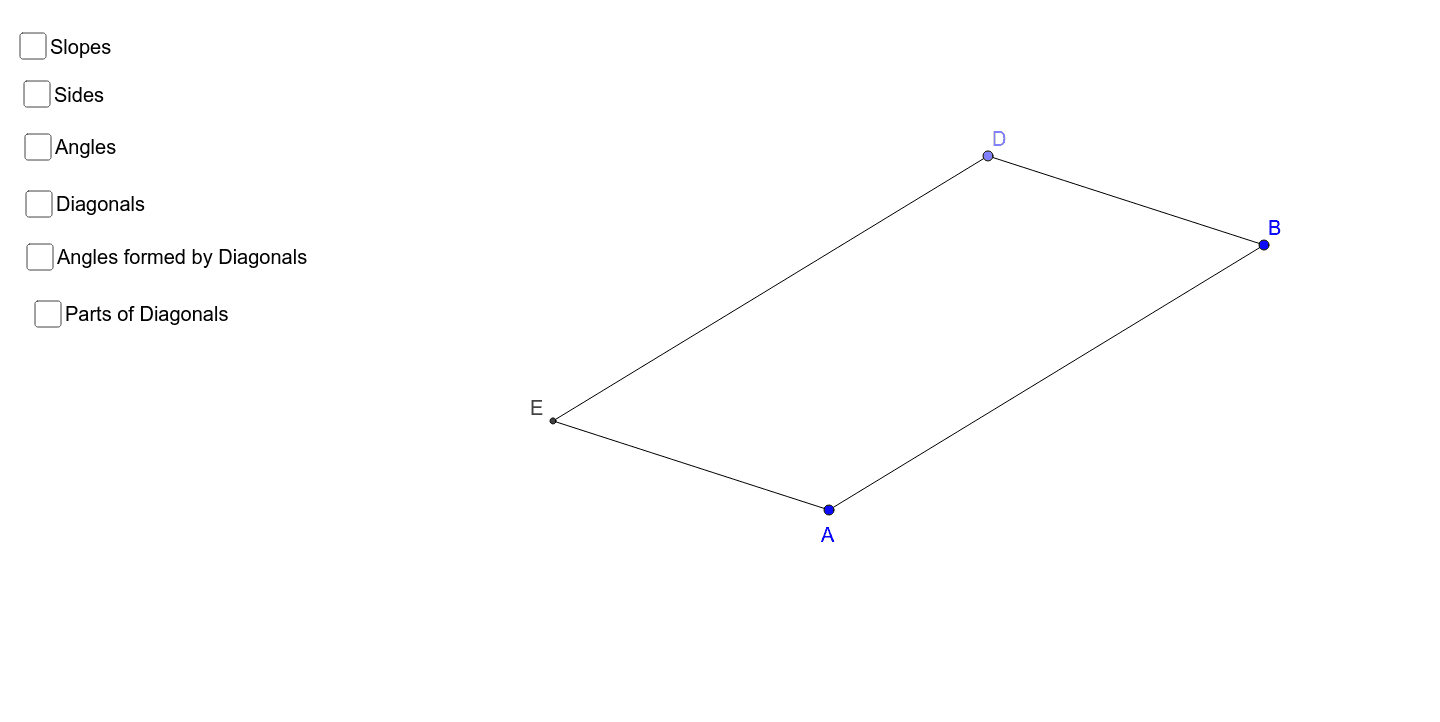
This example demonstrates the properties of a parallelogram. Key mathematical concepts include parallel lines, diagonals, side lengths, and angles. Using GeoGebra commands such as Segment, Line, and Point, dynamic construction and exploration of parallelogram properties are possible. Suitable for middle school and above students or teachers.
GeoGebra Commands & Parameters
Segment(A, B) → aLine(C, a) → bPoint(b) → DSegment(B, D) → cLine(A, c) → dIntersect(b, d) → ESegment(A, E) → eSegment(E, D) → fSlope(f) → mSlope(a) → m_1Slope(e) → m_2Slope(c) → m_3Distance(E, A) → distanceEADistance(A, B) → distanceABDistance(B, D) → distanceBDDistance(D, E) → distanceDEAngle(B, A, E) → αAngle(A, E, D) → βAngle(E, D, B) → γAngle(D, B, A) → δSegment(E, B) → jSegment(D, A) → kIntersect(j, k) → FAngle(E, F, A) → εAngle(A, F, B) → ζAngle(B, F, D) → ηAngle(D, F, E) → θAngle(E, D, F) → ιAngle(F, E, D) → κAngle(D, B, F) → λAngle(F, D, B) → μAngle(F, B, A) → νAngle(B, A, F) → ξAngle(F, A, E) → οAngle(A, E, F) → ρDistance(E, F) → distanceEFMidpoint(E, F) →Distance(F, B) → distanceFBMidpoint(F, B) →Distance(D, F) → distanceDFMidpoint(D, F) →Distance(F, A) → distanceFAMidpoint(F, A) →