
Parallel Lines and Transversals by Jeff Depue
Loading the math board and drawing, please wait…
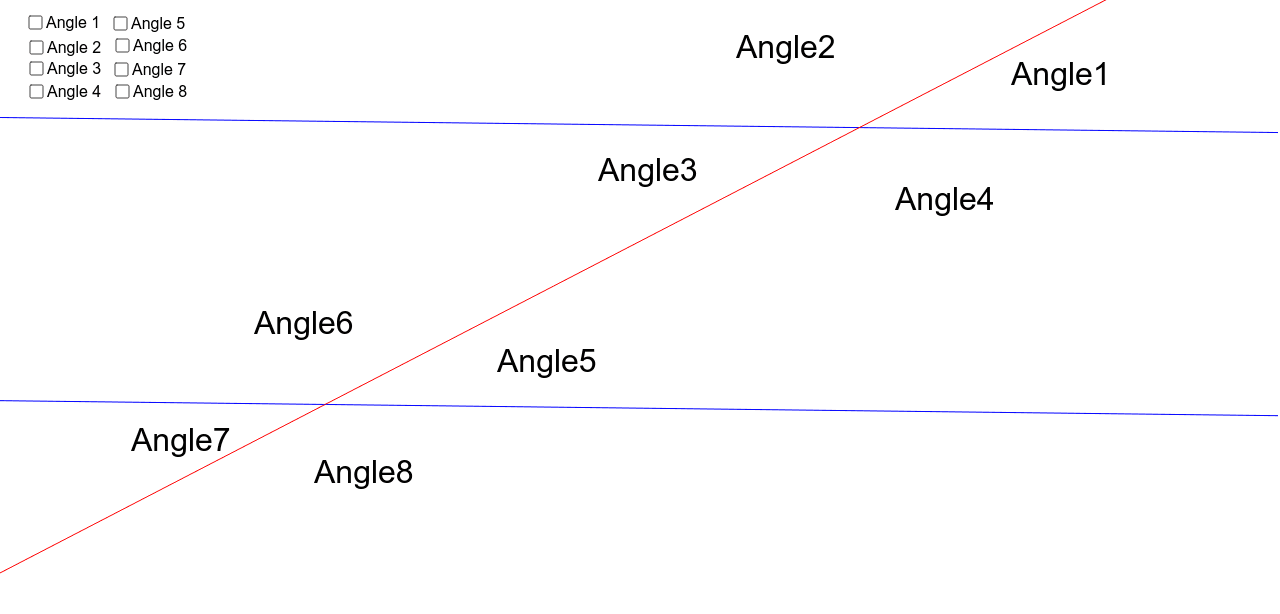
This example demonstrates the relationships between parallel lines and transversals. Key mathematical concepts include the properties of parallel lines and the angles formed by transversals such as corresponding angles, alternate interior angles, and same-side interior angles. Using GeoGebra commands like Line, Point, and Angle, you can construct parallel lines and transversals to observe these angle relationships. Suitable for students in middle school and above.
GeoGebra Commands & Parameters
Line(A, B) → aLine(C, a) → bPoint(a) → DPoint(b) → ELine(D, E) → cPoint(c) → FPoint(b) → GPoint(c) → HAngle(B, D, F) → Angle1Angle(F, D, A) → Angle2Angle(A, D, E) → Angle3Angle(E, D, B) → Angle4Angle(G, E, D) → Angle5Angle(D, E, C) → Angle6Angle(C, E, H) → Angle7Angle(H, E, G) → Angle8
AI Drawing Prompt Reference
Draw two parallel lines a and b, then take point D on line a and point E on line b, and connect DE to form line c. Next, take point F on line c, point G on line b, and point H on line c. Finally, measure the degrees of ∠BDF, ∠FDA, ∠ADE, ∠DEB, ∠GEF, ∠DEF, ∠CEH, and ∠HEG.
The prompt above was compiled from the original drawing commands and is for reference only.