
Parallel Lines and Alternate and Corresponding Angles
Loading the math board and drawing, please wait…
In collections
Introduction to Geometry
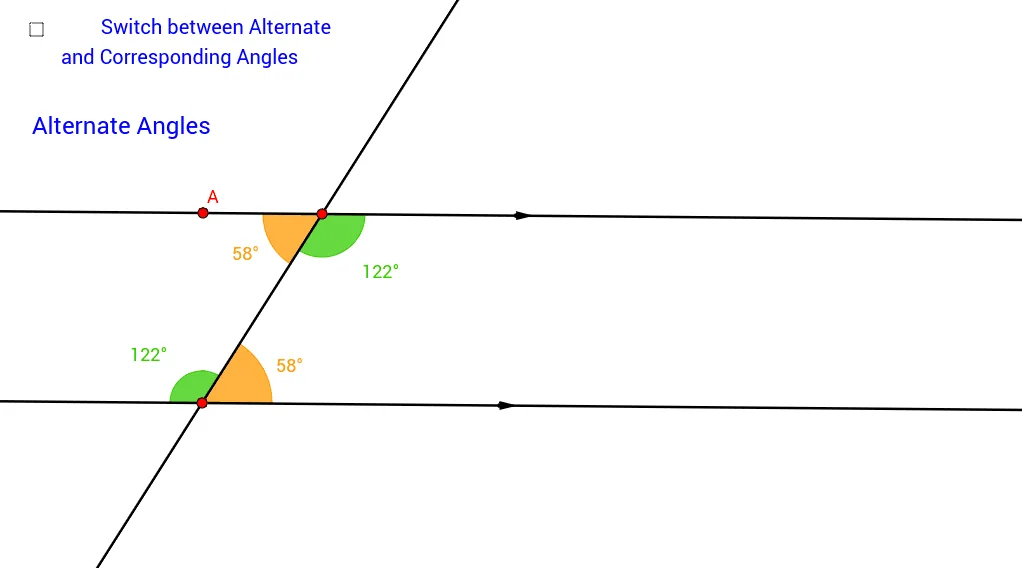
This example demonstrates the relationship between parallel lines and alternate and corresponding angles. By constructing two parallel lines, it shows that alternate angles are equal and corresponding angles are equal. It uses commands like Line, Point, Angle, and Vector in GeoGebra, suitable for middle school and above students to learn geometry.
GeoGebra Commands & Parameters
Line(A, B) → aLine(C, a) → bLine(C, B) → cPoint(a) → DPoint(c) → EPoint(b) → FPoint(c) → GPoint(b) → HAngle(D, B, E) → αAngle(E, B, A) → βAngle(A, B, C) → γAngle(B, C, F) → δAngle(F, C, G) → εAngle(G, C, H) → ζAngle(H, C, B) → ηAngle(C, B, D) → θAngle(b, c) → ιAngle(B, C, F) → οPoint(a) → IPoint(b) → JPoint(a) → KVector(I, K) → uPoint(b) → LVector(J, L) → v
AI Drawing Prompt Reference
Draw two parallel lines and mark two intersection points on them. From these points, draw two line segments that intersect the parallel lines, forming eight angles. Measure and label the sizes of these angles to demonstrate that alternate and corresponding angles are equal, illustrating the geometric properties of parallel lines.
The prompt above was compiled from the original drawing commands and is for reference only.