
Parabolic Car Headlamp: Reflection Principle and Geometric Construction
Loading the math board and drawing, please wait…
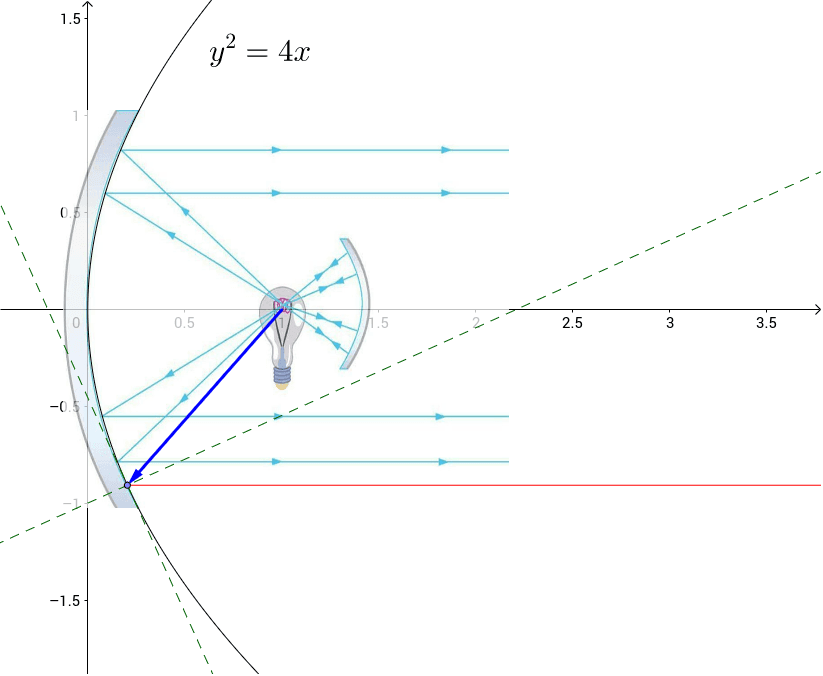
① This GeoGebra example dynamically demonstrates how a parabolic reflective surface directs light rays from the focus into parallel beams, simulating the light-gathering mechanism of a car headlamp. ② Core mathematical concepts include the focus-directrix property of a parabola, the law of reflection (angle of incidence equals angle of reflection), tangent and normal line relationships, and geometric symmetry of light paths. ③ Construction highlights: using OrthogonalLine to create normals, Point, Line, Tangent, Mirror to generate reflected rays, Intersect to find ray-parabola intersections, Ray and Vector to represent light directions, with images (pic1) and text (text1) for enhanced visualization. ④ Suitable for high school or early college students studying analytic geometry, conic section optical properties, or for physics classes on light reflection and mathematical modeling, offering an intuitive view of real-world engineering applications of parabolas.
GeoGebra Commands & Parameters
OrthogonalLine(F, yAxis) → gPoint(g) → EPoint(xAxis) → APoint(c) → BLine(A, B) → aTangent(B, c) → b,OrthogonalLine(B, b) → dMirror(a, d) → a'Point(xAxis) → COrthogonalLine(C, xAxis) → eIntersect(a', e) → DRay(B, D) → fVector(A, B) → uOrthogonalLine(E, g) → hPoint(h) → GTangent(B, c) → i,OrthogonalLine(B, i) → j
AI Drawing Prompt Reference
Draw a parabola to demonstrate the relationship between its focus and directrix, and show how light rays originating from the focus reflect off the parabola to become parallel beams. Start by plotting the focus and directrix of the parabola, then find a point on the parabola and draw its tangent and normal lines. Next, construct reflected light rays using the tangent and normal lines, and mark the intersection points of the rays with the parabola. Finally, represent the light directions with vectors and label the focus, directrix, tangent, normal, and reflected rays to illustrate the optical properties of the parabola.
The prompt above was compiled from the original drawing commands and is for reference only.