
Parabolic Car Headlamp: Reflection and Geometric Construction
Loading the math board and drawing, please wait…
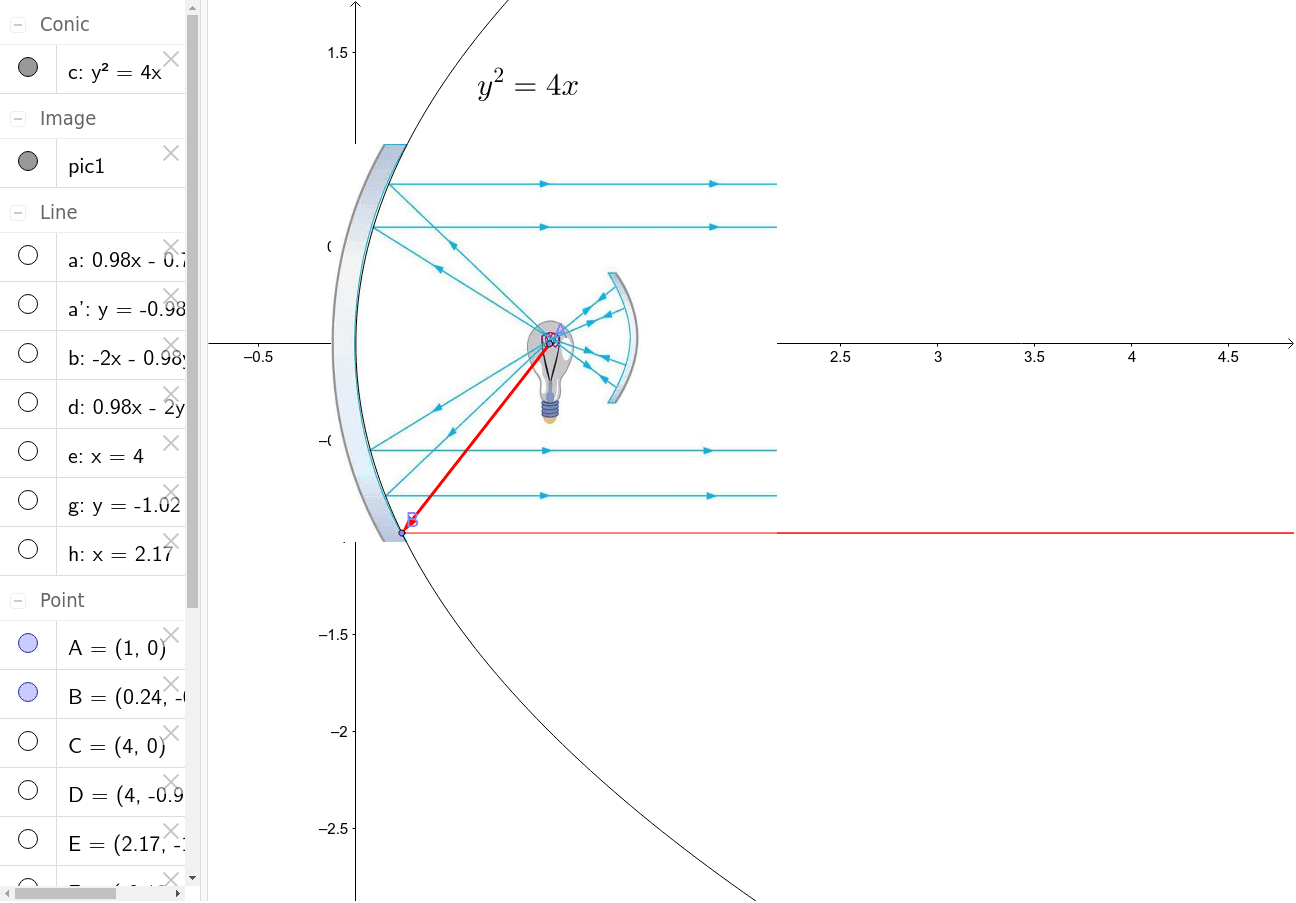
This example demonstrates the application of a parabola in car headlamp design, showing how parallel light rays reflect off the parabolic surface and converge at the focus. The core mathematical concepts include the focus and directrix of a parabola, the law of reflection, and tangent properties. The construction uses GeoGebra commands such as OrthogonalLine, Point, Line, Tangent, Mirror, Intersect, Ray, and Vector, with objects like F (focus), g (directrix), c (parabola), and others to build the model. It is suitable for high school or early college students to understand the optical properties of conic sections, and can serve as interdisciplinary material combining mathematics and physics.
GeoGebra Commands & Parameters
OrthogonalLine(F, yAxis) → gPoint(g) → EPoint(xAxis) → APoint(c) → BLine(A, B) → aTangent(B, c) → b,OrthogonalLine(B, b) → dMirror(a, d) → a'Point(xAxis) → COrthogonalLine(C, xAxis) → eIntersect(a', e) → DRay(B, D) → fVector(A, B) → uOrthogonalLine(E, g) → hPoint(h) → G
AI Drawing Prompt Reference
Draw a parabolic car headlamp reflection model. Parabolic surface reflects parallel light rays, converging at the focus. Parabola defined by focus and directrix, points on parabola equidistant from focus and directrix. Construct by drawing parabola, focus, directrix, then reflection rays, and marking focus and directrix positions.
The prompt above was compiled from the original drawing commands and is for reference only.