
Parabola, Scalene Triangles, and 3D Vectors: Geometric Construction with Arithme
Loading the math board and drawing, please wait…
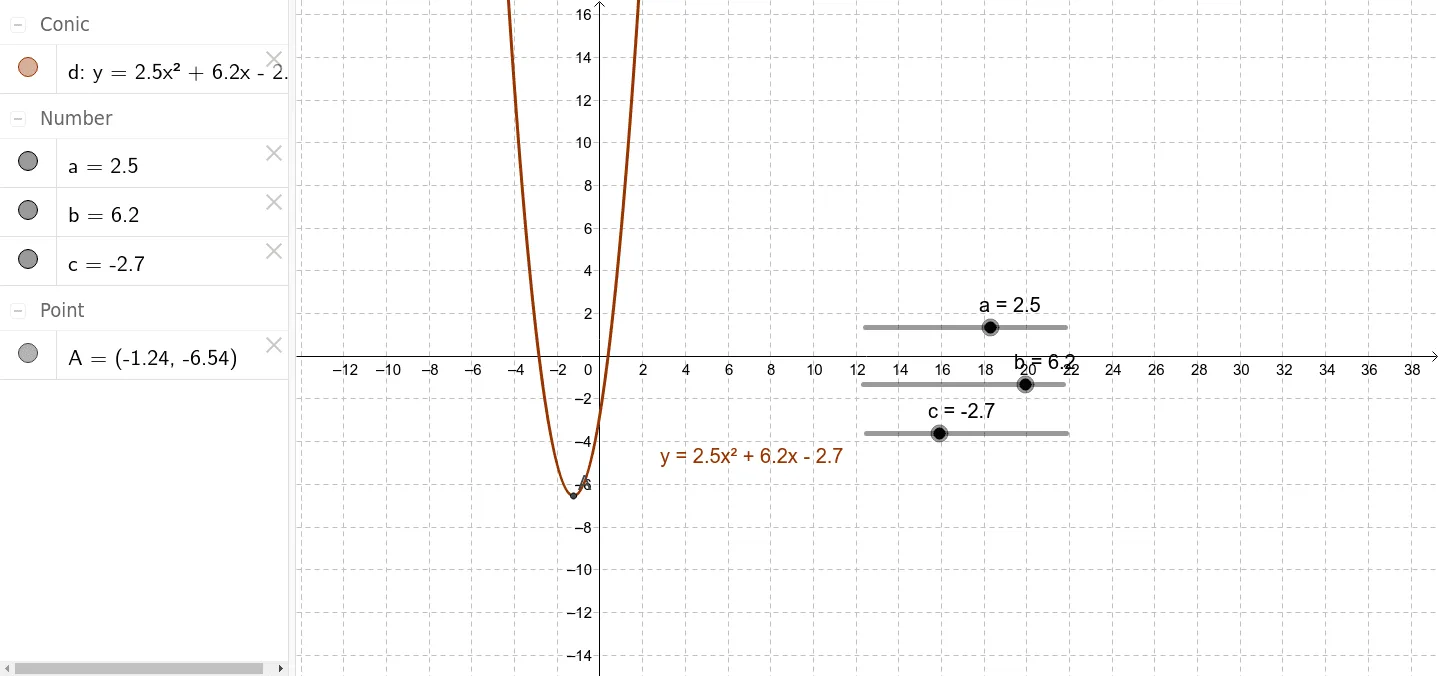
This GeoGebra example demonstrates the interplay between a parabola, scalene triangles, and three-dimensional vectors, incorporating concepts such as arithmetic mean, congruence, and polynomial functions. The construction uses objects a, b, c, d, ac, and A to define the parabola, build a scalene triangle, and represent vectors in 3D space. Users can explore how points on the parabola relate to triangle vertices, vector operations, and mean calculations dynamically. Key construction steps involve setting up point objects for the parabola, creating the triangle, and adding 3D vectors, while verifying properties through arithmetic mean and congruence. Suitable for high school and above, this example aids in teaching analytic geometry, vector algebra, and function graphing, and serves as a visual tool for pre-university mathematics.
GeoGebra Commands & Parameters
Numeric a(2.5)Numeric b(6.2)Numeric c(-2.7)y = (a * x^(2)) + (b * x) + c(a * c)(((-b)) / ((2 * a)), ((4 * ac) - b^(2)) / ((4 * a)))
AI Drawing Prompt Reference
Draw a parabola and construct a scalene triangle along with three-dimensional vectors to illustrate their geometric interactions. Begin by setting parameters for the parabola and plot it accordingly. Then, use these parameters to build a scalene triangle and add three 3D vectors, establishing connections between them, the parabola, and the triangle. Demonstrate how points on the parabola relate to the triangle's vertices, vector operations, and arithmetic mean calculations.
The prompt above was compiled from the original drawing commands and is for reference only.