
PacMath Series: Inequalities Visualization and Geometric Construction
Loading the math board and drawing, please wait…
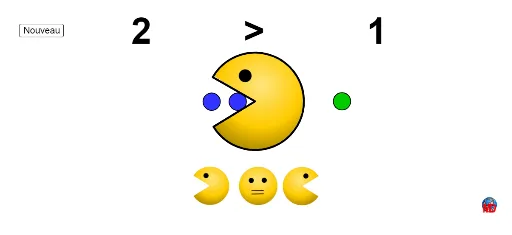
This GeoGebra example, part of the 'PacMath' series, dynamically demonstrates mathematical relationships and geometric constructions related to inequalities. It employs a rich set of commands including Circle, Point, Rotate, CircleSector, Midpoint, Random, Sequence, If, Segment, Mirror, and Mod, creating a complex interactive environment with numerous objects (e.g., disgauche, disdroite, A, R, c, B, B', d, C, image1, etc.). The core mathematical concepts span arithmetic, inequalities, polynomial functions, secant lines, 3D vectors, combinatorics, and indefinite integrals, highlighting cross-disciplinary connections. The construction uses random sequences to generate dynamic point sets, mirror and rotate to create symmetric figures, and conditional statements with sliders (Bouton1) to control the left/right bounds and equality state of inequalities, thereby visually revealing the conditions under which inequalities hold and how they change. This example is suitable for high school to early college students to explore the interplay between inequality properties, function graphs, and geometric intuition, and also serves as a reference for teachers creating interactive lesson materials.
GeoGebra Commands & Parameters
Circle(A, R) → cPoint(c) → BRotate(B, 61°, A) → B'CircleSector(A, B', B) → dMidpoint(B', A) → CRotate(C, 70°, A) → B'_1Random(2, 7) → bbRandom(1, 7) → aaSequence(D + ((1.5 * i), 0), i, 0, aa - 1) → liste1Sequence(Circle[Element[liste1, i], r], i, 1, Length[liste1]) → liste2Sequence(E - ((1.5 * i), 0), i, 0, bb - 1) → liste3Sequence(Circle[Element[liste3, i], r], i, 1, Length[liste3]) → liste4If(bb > aa ∧ b, 1, 0) → gaucheIf(bb ≟ aa ∧ e, 1, 0) → egalIf(aa > bb ∧ a, 1, 0) → droiteSequence(Circle[Element[liste1, i], r], i, 1, Length[liste1]) → liste5Segment(F, A) → fSegment(G, A) → gMirror(image5, F) → image5'Mirror(F, A) → F'Mirror(B, A) → B'_2Segment(B'_2, A) → hSegment(A, F') → iMod((disegale * 10), 2) → egSequence(Circle[Element[liste3, i], r], i, 1, Length[liste3]) → liste6CircleSector(A, F, B) → kCircleSector(A, F', B'_2) → pCircle(A, R) → q