
Orthocenter of a Triangle: Dynamic Construction and Properties
Loading the math board and drawing, please wait…
In collections
Strand 2: Geometry and Trigonometry
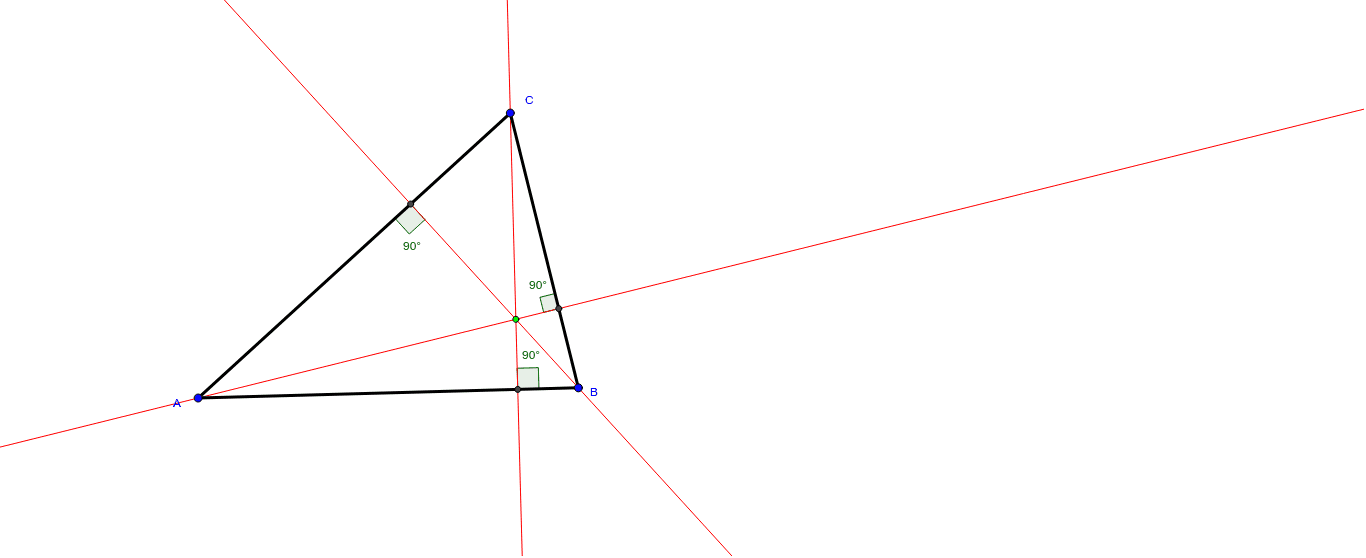
①This GeoGebra example dynamically demonstrates the classic geometric fact that the three altitudes of a triangle intersect at a single point, the orthocenter. ②Core mathematical concepts include the orthocenter, altitudes, perpendicularity, and the positional relationships among the orthocenter, vertices, and sides, with auxiliary circles and trapezoids enriching the construction. ③Construction highlights: using Segment to create triangle sides, OrthogonalLine to draw altitudes through vertices perpendicular to opposite sides, Line and Intersect to find altitude intersections, and Angle to mark relevant angles; objects include vertices A, B, C, sides a, b, c, altitudes d, e, f, intersection points D, E, F, G, and angles α, β, γ, fully revealing the orthocenter's generation. ④Suitable for middle/high school geometry lessons, math lab activities, or self-study, helping learners grasp the definition of the orthocenter and the concurrency of altitudes, while dragging vertices to observe how the orthocenter moves, fostering dynamic geometric reasoning.
GeoGebra Commands & Parameters
Segment(A, B) → aSegment(B, C) → bSegment(A, C) → cOrthogonalLine(A, b) → dOrthogonalLine(B, c) → eOrthogonalLine(C, a) → fLine(C, B) → jLine(B, A) → kLine(A, C) → lOrthogonalLine(A, b) → gOrthogonalLine(C, a) → hOrthogonalLine(B, c) → iIntersect(g, h) → DIntersect(i, c) → EIntersect(g, b) → FIntersect(h, a) → GAngle(B, G, D) → αAngle(C, F, D) → βAngle(A, E, D) → γ
AI Drawing Prompt Reference
Draw a triangle and dynamically demonstrate that its three altitudes intersect at a single point, the orthocenter. First, sketch the three sides of the triangle, then draw perpendicular lines from each vertex to the opposite side to form the altitudes. Identify the intersection point of the altitudes, marking it as the orthocenter. Include auxiliary circles and trapezoids, and label relevant angles to observe how the orthocenter moves as the vertices are dragged, revealing its dynamic geometric relationships.
The prompt above was compiled from the original drawing commands and is for reference only.