
Order of Rotational Symmetry of Regular Polygons
Loading the math board and drawing, please wait…
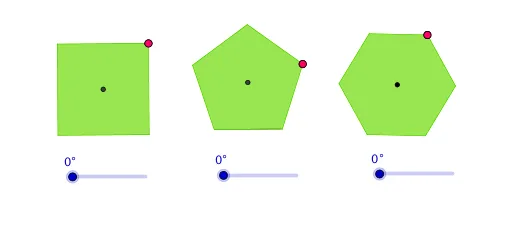
This example demonstrates the order of rotational symmetry of regular polygons. Key mathematical concepts include rotational symmetry and polygons. Using GeoGebra commands such as Polygon and Rotate, one can construct regular polygons and observe their rotational symmetry. Suitable for middle school and above students or teachers.
GeoGebra Commands & Parameters
Line(A, B) → aOrthogonalLine(A, a) → bOrthogonalLine(B, a) → cCircle(A, B) → dIntersect(d, b, 2) → COrthogonalLine(C, b) → eIntersect(e, c) → DPolygon(A, B, D, C) → P, a_1, b_1, d_1, c_1Midpoint(C, B) → ESegment(F, G) → fOrthogonalLine(G, f) → gCircle(G, F) → hIntersect(h, g, 1) → HCircle(H, G) → kIntersect(k, g, 2) → ISegment(F, I) → iCircle(F, I) → pLine(G, F) → jIntersect(p, j, 2) → JMidpoint(J, G) → KSegment(J, K) → lCircle(F, l) → qCircle(G, l) → rIntersect(r, q, 1) → LSegment(F, L) → mSegment(L, G) → nAngularBisector(F, G, L) → sAngularBisector(L, F, G) → tIntersect(r, s, 2) → MIntersect(q, t, 1) → NPolygon(M, L, N, G, F) → Q, m_1, l_1, n_1, g_1, f_1Segment(O, R) → e_1Circle(O, R) → h_1Circle(R, O) → k_1Ray(O, R) → i_1Intersect(k_1, i_1, 2) → SCircle(S, R) → p_1Intersect(k_1, h_1, 2) → TIntersect(p_1, k_1, 2) → UIntersect(p_1, k_1, 1) → VIntersect(k_1, h_1, 1) → WPolygon(T, U, S, V, W, O) → Y, t_1, u, s_1, v, w, oMidpoint(M, L) → ZMidpoint(L, N) → A_1Segment(F, A_1) → j_1Segment(Z, G) → q_1Intersect(q_1, j_1) → B_1Rotate(A, α, E) → A'Rotate(B, α, E) → B'Rotate(D, α, E) → D'Rotate(C, α, E) → C'Polygon(A', B', D', C') → P', a', b', d', c'Rotate(M, β, B_1) → M'Rotate(L, β, B_1) → L'Rotate(N, β, B_1) → N'Rotate(G, β, B_1) → G'Rotate(F, β, B_1) → F'Polygon(M', L', N', G', F') → Q', m', l', n', g', f'Rotate(T, γ, R) → T'Rotate(U, γ, R) → U'Rotate(S, γ, R) → S'Rotate(V, γ, R) → V'Rotate(W, γ, R) → W'Rotate(O, γ, R) → O'Polygon(T', U', S', V', W', O') → Y', t', u', s', v', w', o'