
Optimist Cup
Loading the math board and drawing, please wait…
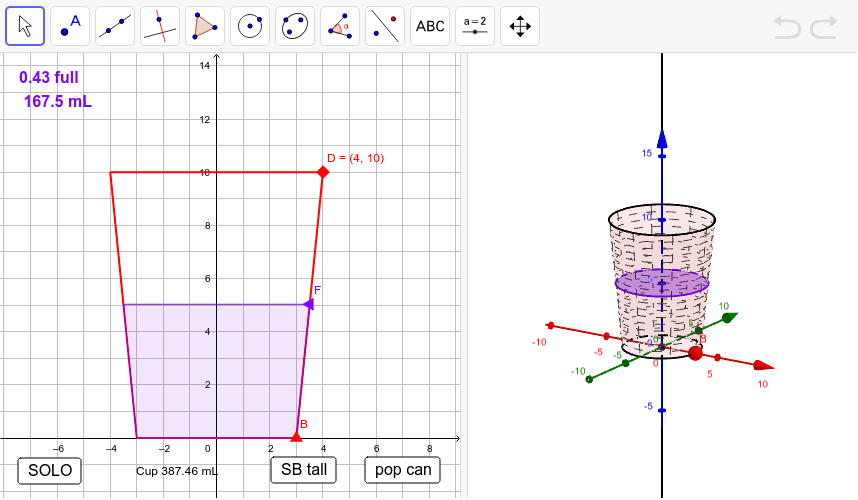
This example explores the volume of cups. Half full might be harder than you think! It involves volume calculation and uses points, lines, circles, polygons, and other GeoGebra objects, suitable for high school math education.
GeoGebra Commands & Parameters
Point(Ray[A, A + (1, 0)]) → BPointIn(a) → DRay(A, C) → fPoint(Segment[B, D]) → FMirror(F, f) → E'Mirror(B, f) → B'Polygon(B', B, F, E') → poly1, h, i, j, kMirror(D, C) → D'Polygon(B', B, D, D') → poly2, l, m, n, pPolyLine(B', B, D, D', B') → gLine((0, 0, 0), (0, 0, 1)) → qCircle(q, B) → cCircle(q, (x(D), 0, y(D))) → dCircle(q, (x(F), 0, y(F))) → eLine((0, 0, 0), (0, 1, 0)) → f_1Surface((r(t) * cos(s)), (r(t) * sin(s)), t, s, 0, (2 * π), t, 0, y(D)) → u
AI Drawing Prompt Reference
Draw a 3D solid figure illustrating a cup volume optimization problem. Start with a horizontal ray and place a point on it as the cup rim edge. Pick a point inside a circle on one side, connect it to the rim point to form a segment, and choose a point on this segment as a wall marker. Reflect the rim point and marker across the ray to get symmetric points, then form a quadrilateral for the side profile. Reflect the interior point across the circle center to get another point, and form a second quadrilateral with the rim and interior points for the base. Connect key points with a polyline to outline the cup. Then use a vertical axis and draw three horizontal circles through the rim, interior, and marker points to show cross-sections. Finally, generate a surface of revolution to create the cup's solid body, demonstrating the volume at half-full state.
The prompt above was compiled from the original drawing commands and is for reference only.