
Octagon Properties: Incircle, Rotation and Symmetry Transformations
Loading the math board and drawing, please wait…
In collections
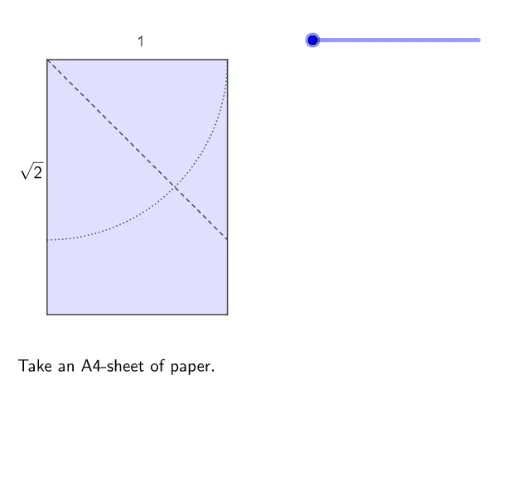
Folding paper, doing geometry figures
This GeoGebra example dynamically explores the geometric properties of a regular octagon, including its incircle, circumcircle, axes of symmetry, and rotational symmetry. Core mathematical concepts include properties of regular polygons, relationships between incircle and circumcircle, angle calculations (e.g., central angle 45°), symmetry transformations (rotation and reflection), and vector translation. Construction highlights: the Polygon command creates the octagon, Circle commands draw incircle and circumcircle, Rotate and Mirror commands demonstrate symmetry, Midpoint and Angle commands measure key angles, Sequence generates repeated structures, and Translate with Vector duplicates shapes. Suitable for middle school to high school students learning regular polygon properties, geometric transformations, and circle geometry. It serves as an interactive tool for classroom demonstrations or self-study, visually reinforcing the symmetry and mathematical patterns of a regular octagon.
GeoGebra Commands & Parameters
Polygon(A, C, D, B) → vierhoek1, a, c, d, bSegment(DD, E) → fVector((0, -0.15)) → uPolygon(B, DD, E, D) → vierhoek2, b_1, dd, e, d_1Polygon(A, C, E, DD) → vierhoek3, a_1, c_1, e_1, dd_1If(s < 1, vierhoek3, If[1 < s ≤ 2, Polygon[Translate[A, Vector[((s - 1) * u)]], Translate[C, Vector[((s - 1) * u)]], Translate[E, Vector[((s - 1) * u)]], Translate[DD, Vector[((s - 1) * u)]]], Polygon[Translate[A, u], Translate[C, u], Translate[E, u], Translate[DD, u]]]) → vierhoek4Vector(D, B) → vTranslate(afbeelding1, Vector[(1.25 * ((s - 1) * v))]) → afbeelding1'Segment(B, E) → gCircleArc(B, DD, D) → hSegment(DD, D) → iPolygon(A2, A1, D1, D2) → vierhoek5, a2, a1, d1, d2Mirror(D, d1) → DBMirror(DD, a2) → DDBCircleArc(D2, DB, D) → kCircleArc(A2, DD, DDB) → pPolygon(B, A2, A1, E, D1, D2) → veelhoek1, b_2, a2_1, a1_1, e_2, d1_1, d2_1Polygon(D1, D, D2) → driehoek1, d2_2, d1_2, d_2Rotate(D1, (((-(s - 3)) * 180))°, d1) → D1'Rotate(D, (((-(s - 3)) * 180))°, d1) → D'Rotate(D2, (((-(s - 3)) * 180))°, d1) → D2'Polygon(D1', D', D2') → driehoek1', d2', d1', d'Polygon(D2, DB, D1) → driehoek2, d1_3, d2_3, dbMidpoint(B, E) → MRotate(D2, 180°, M) → D2'_1Rotate(DB, 180°, M) → DB'Rotate(D1, 180°, M) → D1'_1Polygon(D2'_1, DB', D1'_1) → driehoek2', d1'_1, d2'_1, db'Polygon(B, B1, B2) → driehoek4, b2, b_3, b1Polygon(A2, DD, A1) → driehoek3, a1_2, a2_2, dd_2Rotate(A2, (((-(s - 3)) * 180))°, a2) → A2'Rotate(DD, (((-(s - 3)) * 180))°, a2) → DD'Rotate(A1, (((-(s - 3)) * 180))°, a2) → A1'Polygon(A2', DD', A1') → driehoek3', a1', a2', dd'Polygon(B2, B1, A2, A1, C1, C2, D1, D2) → veelhoek2, b2_1, b1_1, a2_3, a1_3, c1, c2, d1_4, d2_4Polygon(B1, C1, C2, B2) → vierhoek6, b1_2, c1_1, c2_1, b2_2Segment(DDB, DB) → jRotate(B, (((s - 5) * 180))°, b_3) → B'Rotate(B1, (((s - 5) * 180))°, b_3) → B1'Rotate(B2, (((s - 5) * 180))°, b_3) → B2'Polygon(B', B1', B2') → driehoek4', b2', b', b1'Polygon(B2, B1, A2, A1, C1, C2, D1, D2) → veelhoek3, b2_3, b1_3, a2_4, a1_4, c1_2, c2_2, d1_5, d2_5Rotate(C1, (((-(s - 5)) * 180))°, c1) → C1'Rotate(E, (((-(s - 5)) * 180))°, c1) → E'Rotate(C2, (((-(s - 5)) * 180))°, c1) → C2'Polygon(C1', E', C2') → driehoek5', c2', c1', e'Rotate(DDB, 90°, M) → DDB'Rotate(DB, 90°, M) → DB'_1Segment(DDB', DB'_1) → j'Polygon(B1, DB'_1, B2) → driehoek5, b2_4, b1_4, db'_1Polygon(C1, DDB', C2) → driehoek6, c2_3, c1_3, ddb'Rotate(B1, (((-(s - 6)) * 45))°, M) → B1'_1Rotate(C1, (((-(s - 6)) * 45))°, M) → C1'_1Rotate(C2, (((-(s - 6)) * 45))°, M) → C2'_1Rotate(B2, (((-(s - 6)) * 45))°, M) → B2'_1Polygon(B1'_1, C1'_1, C2'_1, B2'_1) → vierhoek6', b1'_1, c1'_1, c2'_1, b2'_1Mirror(B2, M) → E1Mirror(B1, M) → E2Mirror(B, b2_2) → BBMirror(BB, M) → EECircleArc(B1, BB, B) → qCircleArc(C1, E, EE) → rSegment(D2, D) → lSegment(D1, D) → mSegment(DD, A1) → nSegment(DD, A2) → tSegment(B, B2) → f_1Segment(B, B1) → g_1Segment(E, C1) → h_1Segment(E, C2) → i_1Angle(D1, D2, D) → αAngle(A2, A1, DD) → βAngle(B, B2, B1) → γAngle(E, C1, C2) → δAngle(B1, B2, D2) → hoekAngle(B2, D2, D1) → εAngle(D2, D1, C2) → ζAngle(D1, C2, C1) → ηAngle(C2, C1, A1) → θAngle(C1, A1, A2) → ιAngle(A1, A2, B1) → κAngle(A2, B1, B2) → λCircle(M, B1) → k_1Point(k_1) → HMirror(H, M) → H'Segment(H, H') → j_1Circle(M, 0.6) → p_1Line(B, EE) → l_1Intersect(p_1, l_1, 1) → IIntersect(p_1, l_1, 2) → JSegment(I, J) → m_1Sequence(Segment[Rotate[I, ((nn * 22.5))°, M], Rotate[J, ((nn * 22.5))°, M]], nn, 1, 8) → lijst_1