
Obtuse Angle Test
Loading the math board and drawing, please wait…
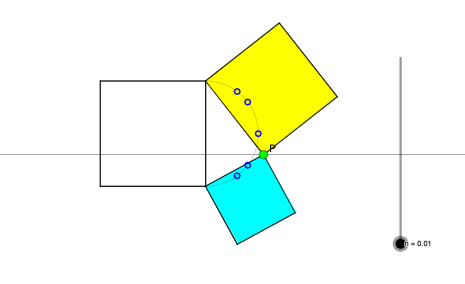
This example demonstrates the properties of obtuse angles. Key mathematical concepts include the definition of an obtuse angle and its application in triangles. Using GeoGebra commands such as Point, Semicircle, Intersect, etc., an obtuse triangle can be constructed and its properties observed. Suitable for middle school and above students to learn about obtuse triangles.
GeoGebra Commands & Parameters
Point(yAxis) → APoint(yAxis) → BSemicircle(A, B) → cPoint(c) → CPoint(c) → DIntersect(c, xAxis, 1) → EPoint(c) → FPoint(c) → GPolygon(A, H, 4) → poly1, f, g, h, i, I, JPolygon(H, B, 4) → poly2, j, k, l, m, K, LPolygon(B, A, 4) → poly3, n_{1}, p, q, r, M, NOrthogonalLine(H, n_{1}) → sLine(J, I) → tLine(K, L) → aIntersect(s, a) → OIntersect(s, t) → PIf(0 ≤ n < 1, Polygon[Dilate[L, 1 - n, O], K + Dilate[L, 1 - n, O] - L, B, H], If[n ≥ 1, Polygon[O, H, B, K + O - L]]) → q2If(2 ≤ n < 3, Translate[q2, ((n - 2) * (H - O))], Translate[q2, H - O]) → q1Intersect(n_{1}, s) → QIf(4 ≤ n < 5, Polygon[B + H - O, B, H + ((n - 4) * (Q - H)), H + ((n - 4) * (Q - H)) + H - O], If[n ≥ 5, Polygon[B, B + H - O, Q + H - O, Q]]) → q3If(6 ≤ n < 7, Polygon[H, A, J + Dilate[I, 7 - n, P] - I, Dilate[I, 7 - n, P]], If[n ≥ 7, Polygon[A, H, P, J + P - I], Polygon[A, H, I, J]]) → q4If(8 ≤ n < 9, Polygon[A + ((n - 8) * (H - P)), H + ((n - 8) * (H - P)), P + ((n - 8) * (H - P)), A + ((n - 8) * (H - P)) + P - H], If[n ≥ 9, Polygon[A, H, H + H - P, A + H - P]]) → q5If(10 ≤ n ≤ 11, Polygon[A + H - P, A, H + ((n - 10) * (Q - H)), H + H - P + ((n - 10) * (Q - H))]) → q6
AI Drawing Prompt Reference
In a coordinate plane, choose two points on the y-axis as endpoints, then draw the semicircle having those points as its diameter. Select several points on the semicircle to form a curved, arc-like boundary, and include the intersection of the semicircle with the x-axis as a main reference point. Using lines derived from the y-axis points and selected arc points, construct additional intersection points needed for supporting the figure, including the intersection of a perpendicular reference line with two side lines. Then generate a sequence of polygonal regions by shifting and interpolating the earlier polygon shapes across different ranges, creating a multi-layer arc-and-triangle arrangement. The goal is a visual obtuse-angle test setup that helps observe how an obtuse configuration arises in triangle constructions.
The prompt above was compiled from the original drawing commands and is for reference only.