
Non-Parallel Lines and Angle Relationships
Loading the math board and drawing, please wait…
In collections
Introduction to Geometry
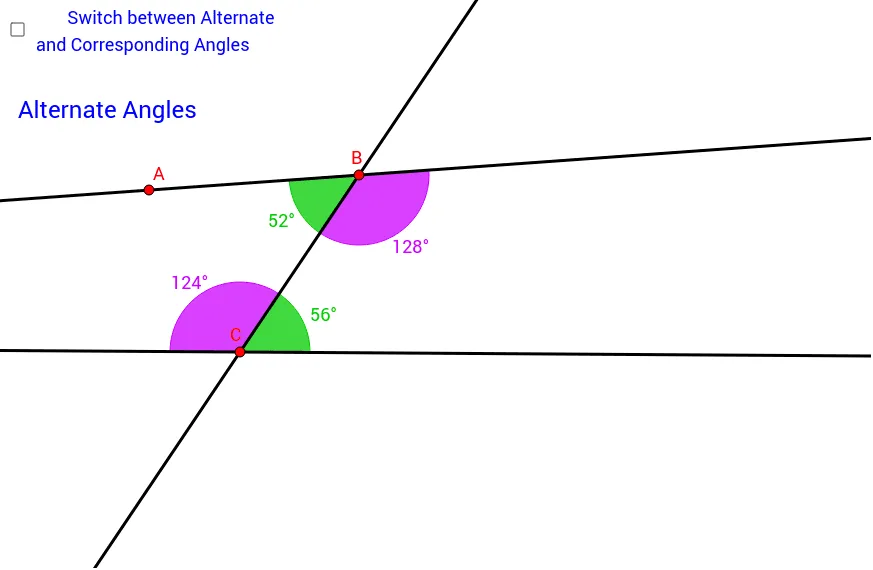
This example dynamically illustrates that alternate and corresponding angles are not equal when lines are non-parallel, emphasizing the importance of parallelism in angle relationships. Key concepts include alternate interior angles, corresponding angles, and properties of parallel lines. Constructed using GeoGebra commands like Line, Point, Angle, Vector, Ray, and Polygon. Suitable for high school geometry education to enhance understanding of parallel line properties and angle relationships.
GeoGebra Commands & Parameters
Line(A, B) → aLine(C, B) → cPoint(a) → D1Point(c) → ELine(C, D) → bPoint(b) → FPoint(c) → GPoint(b) → HAngle(D1, B, E) → αAngle(E, B, A) → βAngle(A, B, C) → γAngle(B, C, F) → δAngle(F, C, G) → εAngle(G, C, H) → ζAngle(H, C, B) → ηAngle(C, B, D1) → θAngle(b, c) → ιAngle(B, C, F) → οPoint(a) → IVector(I, D1) → uVector(D, H) → vRay(G, E) → ePolygon(J, K, L, M) → poly1, j, k, l, m
AI Drawing Prompt Reference
Draw two non-parallel lines a and c, and their intersection points D1, E, F, G, and H. Mark angles α, β, γ, δ, ε, ζ, η, and θ. Draw vectors u and v, and ray e. Finally, draw quadrilateral J, K, L, and M.
The prompt above was compiled from the original drawing commands and is for reference only.