
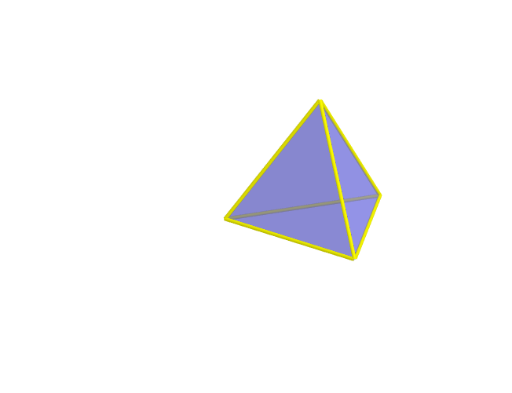
Nets of Tetrahedron
Loading the math board and drawing, please wait…
In collections
3D Geometry & Cross Sections
Surface Area and Volume
Nets of Solid Figures (Primary 6)
Nets of 3D Figures 立體圖形的摺紙圖樣
This example demonstrates the net of a tetrahedron and its fundamental properties. Key math concepts include solid geometry, polygons, and angle calculations. The construction utilizes GeoGebra commands and objects such as Tetrahedron, OrthogonalPlane, IntersectPath, Intersect, Angle, Rotate, OrthogonalLine, Polygon, and Segment. It is suitable for high school students learning solid geometry or for educational demonstrations.
GeoGebra Commands & Parameters
Tetrahedron(A, B, xOyPlane) → a, C, edgeAD_1, edgeCD, edgeBD_1, D, faceABC, faceACD, faceABD, faceBCD, edgeAC, edgeAB, edgeBCTetrahedron(D, B, xOyPlane) → c, E, edgeDF, edgeEF, edgeBF, F, faceBDE, faceDEF, faceBDF, faceBEF, edgeDE, edgeBD_2, edgeBEOrthogonalPlane(D, edgeAB) → dIntersectPath(d, xOyPlane) → eIntersectPath(d, faceABD) → fIntersect(d, faceABD) → I, JAngle(f, e) → αRotate(faceABD, (t * α), edgeAB) → faceABD'OrthogonalLine(D, xOyPlane) → gRotate(faceABD', 120°, g) → faceABD''Rotate(faceABD'', 120°, g) → faceABD'''Polygon(A, B, C) → poly1, c_1, a_1, b_1Rotate(D, (t * α), edgeAB) → D'Rotate(A, (t * α), edgeAB) → A'Segment(D', A') → hRotate(Rotate[faceACD, (t * α), edgeAB], (-((t * α))), h) → faceACD''Rotate(Segment[Rotate[C, (t * α), edgeAB], Rotate[D, (t * α), edgeAB]], (-((t * α))), h) → iRotate(Rotate[Rotate[faceBCD, (t * α), edgeAB], (-((t * α))), h], (t * α), i) → poly2Rotate(Rotate[Rotate[C, (t * α), edgeAB], (-((t * α))), h], (t * α), i) → KRotate(Rotate[Rotate[B, (t * α), edgeAB], (-((t * α))), h], (t * α), i) → LSegment(K, A) → jSegment(K, D') → kSegment(D', L) → lSegment(L, K) → mSegment(D', B) → nRotate(D', 120°, g) → D''Rotate(D', (-(120°)), g) → D''_1Segment(D', B) → pSegment(B, D'') → qSegment(D'', C) → rSegment(C, D''_1) → sSegment(D''_1, A) → d_1Segment(A', D') → e_1