
Net of a Cylinder by Norm Prokup
Loading the math board and drawing, please wait…
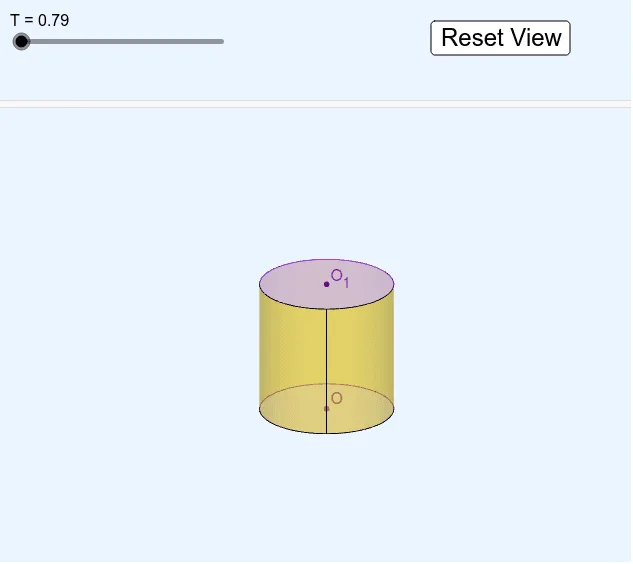
① This GeoGebra example dynamically demonstrates the unfolding of a cylinder's surface into a plane net, showing how the lateral surface becomes a rectangle and the top/bottom bases become circles. ② Core mathematical concepts include solid geometry of cylinders, nets, surface area calculation, and basic geometric elements such as circles, rectangles, and coordinate transformations. ③ Construction highlights: using GeoGebra commands like Line, Surface, Circle, Rotate, and CurveCartesian to build the cylinder and its unfolding process, involving objects such as height h, base radius g, rotation angle θ_max, a button (button1) to control animation, and auxiliary points (O, O_1, O_2) and curves (f, a, v, c, d, etc.) to achieve dynamic rotation and curve drawing. ④ Suitable for middle and high school geometry classes, this resource helps students understand the derivation of the cylinder's surface area formula and supports exploratory learning in mathematics labs.
GeoGebra Commands & Parameters
Line((0, 0, h), Vector[(0, 1, 0)]) → gLine(O_2, Q) → fSurface(x(Q) - (tanT * cos(u)), y(Q) + (tanT * sin(u)), z(Q) + z, u, (-θ_{max}), θ_{max}, z, 0, h) → aCircle((1, 0, h), (0, 0, h), v) → cCircle((1, 0, 0), (0, 0, 0), v) → dRotate(c, (-2 * T) + π / 2, g) → c'Line((0, 0, 0), Vector[(0, 1, 0)]) → g_1Rotate(d, (2 * T) - π / 2, g_1) → d'CurveCartesian(x(Q) - (tanT * cos(θ_{max})), y(Q) + (tanT * sin(θ_{max})), z(Q) + z, z, 0, h) → bCurveCartesian(x(Q) - (tanT * cos((-θ_{max}))), y(Q) + (tanT * sin((-θ_{max}))), z(Q) + z, z, 0, h) → b_1CurveCartesian(x(Q) - (tanT * cos(u)), y(Q) + (tanT * sin(u)), z(Q), u, (-θ_{max}), θ_{max}) → eCurveCartesian(x(Q) - (tanT * cos(u)), y(Q) + (tanT * sin(u)), z(O_2), u, (-θ_{max}), θ_{max}) → e_1Rotate((1, 0, h), (-2 * T) + π / 2, g) → O_1Rotate((1, 0, 0), (2 * T) - π / 2, g_1) → O