
Negative Numbers Multiplication and Division Pyramid
Loading the math board and drawing, please wait…
In collections
Module 1: Negative numbers
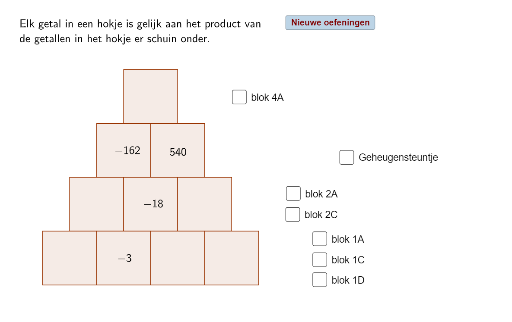
This example uses a pyramid model to demonstrate the multiplication and division of negative numbers. Key mathematical concepts include the rules of operations with negative numbers. Construction highlights include the use of Intersect, Point, Polygon, and Random commands to build the pyramid model. Suitable for middle school and above students to learn negative number operations.
GeoGebra Commands & Parameters
Intersect(xAxis, yAxis) → APoint(xAxis) → BPolygon(A, B, 4) → veelhoek1, a, b, c, d, C, DPoint(xAxis) → EPolygon(B, E, 4) → veelhoek2, b_1, e, f, g, F, GPoint(xAxis) → HPolygon(E, H, 4) → veelhoek3, e_1, h, i, j, I, JPoint(xAxis) → KPolygon(H, K, 4) → veelhoek4, h_1, k, l, m, L, MPoint(c) → NPoint(f) → OPolygon(N, O, 4) → veelhoek5, n, o, p, q, P, QPoint(i) → RPolygon(O, R, 4) → veelhoek6, o_1, r, s, t, S, TPoint(l) → UPolygon(R, U, 4) → veelhoek7, r_1, u, a_1, c_1, V, WPoint(p) → ZPolygon(Z, A_1, 4) → veelhoek8, z, a_2, d_1, f_1, B_1, C_1Point(a_1) → D_1Polygon(A_1, D_1, 4) → veelhoek9, a_3, d_2, g_1, i_1, E_1, F_1Point(d_1) → G_1Point(g_1) → H_1Polygon(G_1, H_1, 4) → veelhoek10, g_2, h_2, j_1, k_1, I_1, J_1Random(-5, -1) → vRandom(-6, -1) → wRandom(1, 6) → l_1Random(-6, -1) → m_1
AI Drawing Prompt Reference
Draw a pyramid model to demonstrate the multiplication and division of negative numbers. Start by creating points A, B, E, H, and K on the x-axis, then draw four equilateral quadrilaterals from these points to form the base of the pyramid. Next, create new points N, O, R, U, and Z at the vertices of these quadrilaterals, and draw five more equilateral quadrilaterals from these points to form the second layer of the pyramid. Finally, create new points D1, G1, and H1 at the vertices of these quadrilaterals, and draw three more equilateral quadrilaterals from these points to form the top layer of the pyramid. Randomly select negative and positive numbers as the side lengths of the quadrilaterals.
The prompt above was compiled from the original drawing commands and is for reference only.